Page 49 - World of Animals - Issue #29
P. 49
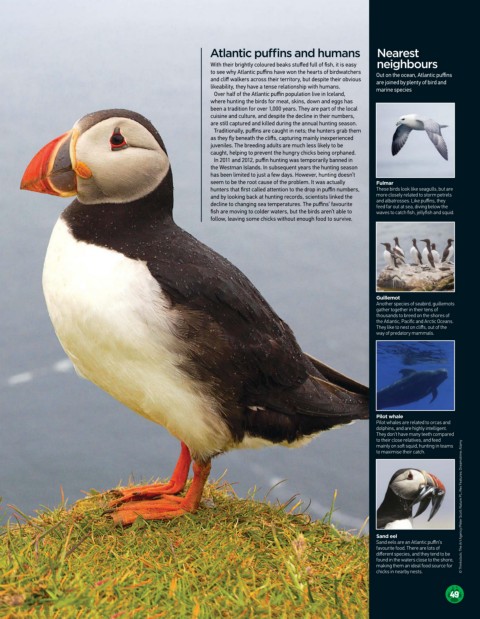
Atlantic puffins and humans                       Nearest


                                                              With their brightly coloured beaks stuffed full of fish, it is easy   neighbours

                                                              to see why Atlantic puffi ns have won the hearts of birdwatchers   Out on the ocean, Atlantic puffi ns


                                                              and cliff walkers across their territory, but despite their obvious   are joined by plenty of bird and
                                                              likeability, they have a tense relationship with humans.   marine species
                                                               Over half of the Atlantic puffi n population live in Iceland,

                                                              where hunting the birds for meat, skins, down and eggs has
                                                              been a tradition for over 1,000 years. They are part of the local
                                                              cuisine and culture, and despite the decline in their numbers,
                                                              are still captured and killed during the annual hunting season.

                                                               Traditionally, puffi ns are caught in nets; the hunters grab them


                                                              as they fly beneath the cliffs, capturing mainly inexperienced
                                                              juveniles. The breeding adults are much less likely to be
                                                              caught, helping to prevent the hungry chicks being orphaned.

                                                               In 2011 and 2012, puffi n hunting was temporarily banned in
                                                              the Westman Islands. In subsequent years the hunting season
                                                              has been limited to just a few days. However, hunting doesn’t
                                                              seem to be the root cause of the problem. It was actually   Fulmar
                                                              hunters that first called attention to the drop in puffi n numbers,   These birds look like seagulls, but are


                                                              and by looking back at hunting records, scientists linked the   more closely related to storm petrels
                                                                                                           and albatrosses. Like puffi ns, they

                                                              decline to changing sea temperatures. The puffi ns’ favourite   feed far out at sea, diving below the

                                                              fish are moving to colder waters, but the birds aren’t able to   waves to catch fish, jellyfish and squid.


                                                              follow, leaving some chicks without enough food to survive.
                                                                                                           Guillemot
                                                                                                           Another species of seabird, guillemots
                                                                                                           gather together in their tens of
                                                                                                           thousands to breed on the shores of

                                                                                                           the Atlantic, Pacific and Arctic Oceans.

                                                                                                           They like to nest on cliffs, out of the
                                                                                                           way of predatory mammals.


                                                                                                           Pilot whale
                                                                                                           Pilot whales are related to orcas and
                                                                                                           dolphins, and are highly intelligent.
                                                                                                           They don’t have many teeth compared
                                                                                                           to their close relatives, and feed

                                                                                                           mainly on so… squid, hunting in teams
                                                                                                           to maximise their catch.


                                                                                                           Sand eel                © Thinkstock; The Art Agency/Peter Scott; Nature PL; Rex Features; Dreamstime; Alamy
                                                                                                           Sand eels are an Atlantic puffi n’s

                                                                                                           favourite food. There are lots of

                                                                                                           different species, and they tend to be
                                                                                                           found in the waters close to the shore,
                                                                                                           making them an ideal food source for
                                                                                                           chicks in nearby nests.
                                                                                                                               49
   44   45   46   47   48   49   50   51   52   53   54