


Page 50 - World of Animals - Issue #29
P. 50
Top 5 life-saving
wildlife technologies
w i l dl i f e t e c h n ol o gi e s
As technology has advanced, it has become an together. For example, whale populations in UK
i
t
o
n
e
d b
o
r
t
e
w
a
r
e m
r
s a
h
e h
s i
n t
d
s
a
n
S d
e
y G
P
c
e
v
i
essential part of animal conservation. Animal waters are monitored by GPS devices in the hands
science ranges from monitoring critter numbers of the general public. Accurately recording the
to restoring their DNA, and even everyday location of whale sightings builds up a picture of
technology has become a crucial part of which areas should be protected, thereby keeping
v
e
d e
h
. T
a
conservation. Organisations are increasingly whales safe. There are apps, toys and even objects
e
e
f
n
, t
o
p
s
p
e a
e a
r
s a
r
y
h
j
a
b
w
t
s
e
c
l
s s
e
n o
r
o
i
v
o p
g
l
i
n
f
using citizen science, where members of the in space that can be used to protect wildlife, giving
l
, g
e
i
t w
i
t
e
c
d
a
h
t c
n b
a
e t
n s
i
p
c
a
e
s
e u
d t
public collect their own data, before pooling it all all people the power to make a difference.
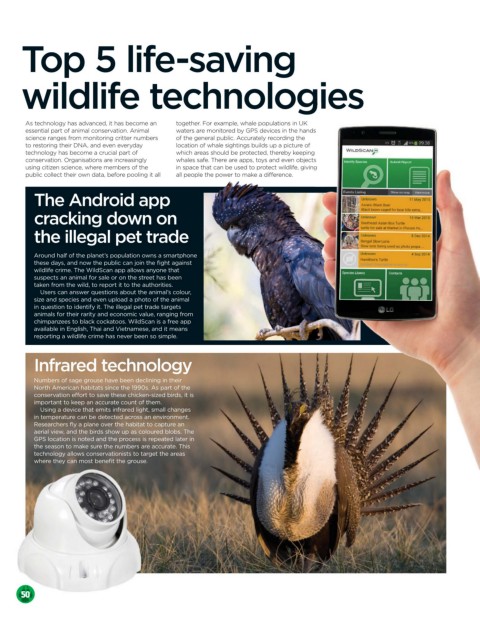
The Android app
cracking down on
the illegal pet trade
Around half of the planet’s population owns a smartphone
these days, and now the public can join the fight against
wildlife crime. The WildScan app allows anyone that
suspects an animal for sale or on the street has been
taken from the wild, to report it to the authorities.
Users can answer questions about the animal’s colour,
size and species and even upload a photo of the animal
in question to identify it. The illegal pet trade targets
animals for their rarity and economic value, ranging from
chimpanzees to black cockatoos. WildScan is a free app
available in English, Thai and Vietnamese, and it means
reporting a wildlife crime has never been so simple.
Infrared technology
Numbers of sage grouse have been declining in their
North American habitats since the 1990s. As part of the
conservation effort to save these chicken-sized birds, it is
important to keep an accurate count of them.
Using a device that emits infrared light, small changes
in temperature can be detected across an environment.
Researchers fly a plane over the habitat to capture an
aerial view, and the birds show up as coloured blobs. The
GPS location is noted and the process is repeated later in
the season to make sure the numbers are accurate. This
technology allows conservationists to target the areas
where they can most benefit the grouse.
where they can most benefi
t the grouse.
50

