


Page 74 - World of Animals - Issue #29
P. 74
Explore the Earth


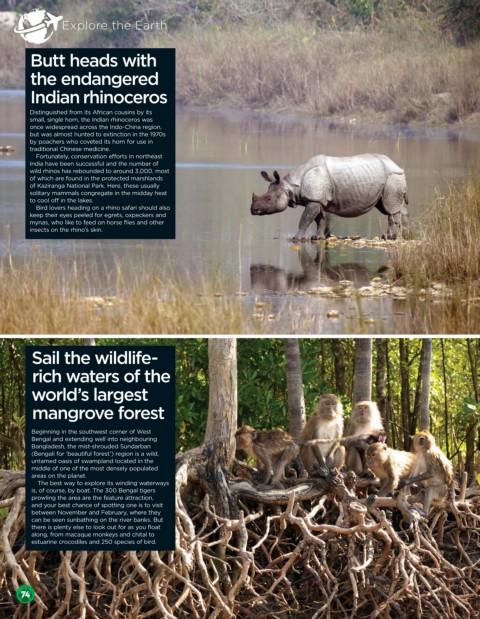
             Butt heads with

             the endangered

             Indian rhinoceros


             Distinguished from its African cousins by its
             small, single horn, the Indian rhinoceros was
             once widespread across the Indo-China region,
             but was almost hunted to extinction in the 1970s
             by poachers who coveted its horn for use in
             traditional Chinese medicine.
               Fortunately, conservation efforts in northeast
             India have been successful and the number of
             wild rhinos has rebounded to around 3,000, most
             of which are found in the protected marshlands
             of Kaziranga National Park. Here, these usually
             solitary mammals congregate in the midday heat
             to cool off in the lakes.
               Bird lovers heading on a rhino safari should also
             keep their eyes peeled for egrets, oxpeckers and
             mynas, who like to feed on horse flies and other
             insects on the rhino’s skin.


              Sail the wildlife-


              rich waters of the

              world’s largest

              mangrove forest


              Beginning in the southwest corner of West
              Bengal and extending well into neighbouring
              Bangladesh, the mist-shrouded Sundarban
              (Bengali for ‘beautiful forest’) region is a wild,
              untamed oasis of swampland located in the
              middle of one of the most densely populated
              areas on the planet.
               The best way to explore its winding waterways
              is, of course, by boat. The 300 Bengal tigers
              prowling the area are the feature attraction,
              and your best chance of spotting one is to visit
              between November and February, where they
              can be seen sunbathing on the river banks. But
              there is plenty else to look out for as you float
              along, from macaque monkeys and chital to
              estuarine crocodiles and 250 species of bird.


           74

