


Page 72 - World of Animals - Issue #29
P. 72
Explore the Earth


           On the prowl for

           India’s big cats


            From lake bottoms to treetops, you’ll
            have to look far and wide to track
            down India’s five fabulous felines


              Bengal tiger


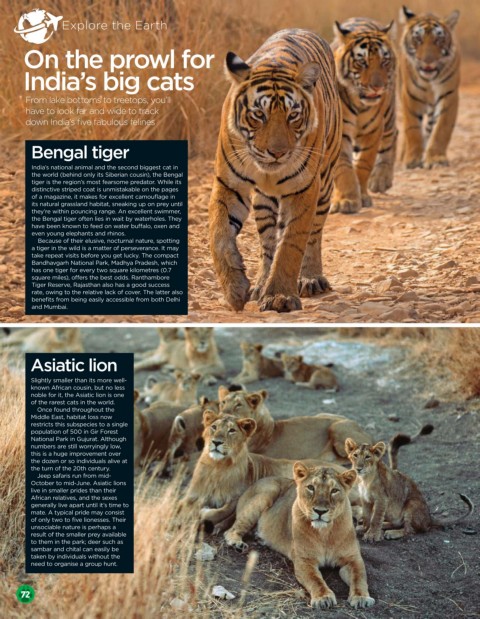
              India’s national animal and the second biggest cat in
              the world (behind only its Siberian cousin), the Bengal
              tiger is the region’s most fearsome predator. While its
              distinctive striped coat is unmistakable on the pages
              of a magazine, it makes for excellent camouflage in
              its natural grassland habitat, sneaking up on prey until
              they’re within pouncing range. An excellent swimmer,
              the Bengal tiger often lies in wait by waterholes. They
              have been known to feed on water buffalo, oxen and
              even young elephants and rhinos.
               Because of their elusive, nocturnal nature, spotting
              a tiger in the wild is a matter of perseverance. It may
              take repeat visits before you get lucky. The compact
              Bandhavgarh National Park, Madhya Pradesh, which
              has one tiger for every two square kilometres (0.7
              square miles), offers the best odds. Ranthambore
              Tiger Reserve, Rajasthan also has a good success
              rate, owing to the relative lack of cover. The latter also
              benefits from being easily accessible from both Delhi
              and Mumbai.


             Asiatic lion

             Slightly smaller than its more well-
             known African cousin, but no less
             noble for it, the Asiatic lion is one
             of the rarest cats in the world.
               Once found throughout the
             Middle East, habitat loss now
             restricts this subspecies to a single
             population of 500 in Gir Forest
             National Park in Gujurat. Although
             numbers are still worryingly low,
             this is a huge improvement over
             the dozen or so individuals alive at
             the turn of the 20th century.
               Jeep safaris run from mid-
             October to mid-June. Asiatic lions
             live in smaller prides than their
             African relatives, and the sexes
             generally live apart until it’s time to
             mate. A typical pride may consist
             of only two to five lionesses. Their
             unsociable nature is perhaps a
             result of the smaller prey available
             to them in the park; deer such as
             sambar and chital can easily be
             taken by individuals without the
             need to organise a group hunt.


           72

