


Page 14 - Dinosaur (DK Eyewitness Books)
P. 14
Jurassic times
                   Laurasia
          Laurasia         Laurasia
           Atlantic
           Ocean            Tethys   TȩȦ ȫȶȳȢȴȴȪȤ ȱȦȳȪȰȥ lasted from around 200 to 145 million years ago.
                             Sea
              Gondwana              It formed the middle part of the Mesozoic Era and is sometimes called the
                                    Age of Giants because huge sauropod dinosaurs flourished at this time.
                                    By now the supercontinent Pangaea had begun to crack. Where a great rift
                                    split apart Earth’s continental crust, the Atlantic Ocean formed and then
                                    widened, separating lands on either side. Moist winds from the seas could

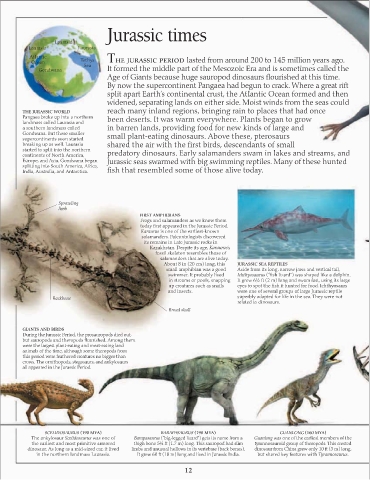
        THE JURASSIC WORLD          reach many inland regions, bringing rain to places that had once
        Pangaea broke up into a northern   been deserts. It was warm everywhere. Plants began to grow
        landmass called Laurasia and
        a southern landmass called   in barren lands, providing food for new kinds of large and
        Gondwana. But these smaller   small plant-eating dinosaurs. Above these, pterosaurs
        supercontinents soon started
        breaking up as well. Laurasia    shared the air with the first birds, descendants of small
        started to split into the northern
        continents of North America,   predatory dinosaurs. Early salamanders swam in lakes and streams, and
        Europe, and Asia. Gondwana began   Jurassic seas swarmed with big swimming reptiles. Many of these hunted
        splitting into South America, Africa,
        India, Australia, and Antarctica.  fish that resembled some of those alive today.


                    Sprawling
                    limb
                                               FIRST AMPHIBIANS
                                               Frogs and salamanders as we know them
                                               today first appeared in the Jurassic Period.
                                                Karaurus is one of the earliest-known
                                                salamanders. Paleontologists discovered
                                                 its remains in Late Jurassic rocks in
                                                   Kazakhstan. Despite its age, Karaurus’s
                                                    fossil skeleton resembles those of
                                                      salamanders that are alive today.
                                                       About 8 in (20 cm) long, this   JURASSIC SEA REPTILES
                                                        small amphibian was a good   Aside from its long, narrow jaws and vertical tail,
                                                         swimmer. It probably lived    Ichthyosaurus (“fish lizard”) was shaped like a dolphin.
                                                         in streams or pools, snapping   It grew 6½ ft (2 m) long and swam fast, using its large
                                                         up creatures such as snails   eyes to spot the fish it hunted for food. Ichthyosaurs
                                                         and insects.           were one of several groups of large Jurassic reptile
                  Backbone                                                      superbly adapted for life in the sea. They were not
                                                                                related to dinosaurs.
                                                         Broad skull


        GIANTS AND BIRDS
        During the Jurassic Period, the prosauropods died out,
        but sauropods and theropods flourished. Among them
        were the largest plant-eating and meat-eating land
        animals of the time, although some theropods from
        this period were feathered creatures no bigger than
        crows. The ornithopods, stegosaurs, and ankylosaurs
        all appeared in the Jurassic Period.


                SCELIDOSAURUS (190 MYA)               BARAPASAURUS (190 MYA)                  GUANLONG (160 MYA)
           The ankylosaur Scelidosaurus was one of   Barapasaurus (“big-legged lizard”) gets its name from a   Guanlong was one of the earliest members of the
           the earliest and most primitive armored   thigh bone 5½ ft (1.7 m) long. This sauropod had slim   tyrannosauroid group of theropods. This crested
          dinosaur. As long as a mid-sized car, it lived    limbs and unusual hollows in its vertebrae (back bones).   dinosaur from China grew only 10 ft (3 m) long,
             in the northern landmass Laurasia.  It grew 60 ft (18 m) long and lived in Jurassic India.  but shared key features with Tyrannosaurus.

                                                              12

