


Page 72 - Dinosaur (DK Eyewitness Books)
P. 72
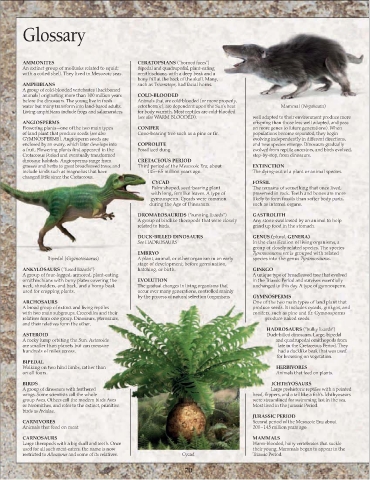
Glossary


        AMMONITES                              CERATOPSIANS (“horned faces“)
        An extinct group of mollusks related to squid;   Bipedal and quadrupedal, plant-eating
        with a coiled shell. They lived in Mesozoic seas.  ornithischians, with a deep beak and a
                                               bony frill at the back of the skull. Many,
        AMPHIBIANS                             such as Triceratops, had facial horns.
        A group of cold-blooded vertebrates (backboned
        animals) originating more than 100 million years   CO/'͆B/OO'E'
        before the dinosaurs. The young live in fresh   Animals that are cold-blooded (or more properly,
        water but many transform into land-based adults.   ectothermic), are dependent upon the Sun’s heat   Mammal (Negabaata)
        Living amphibians include frogs and salamanders.  for body warmth. Most reptiles are cold-blooded
                                               (see also WARM-BLOODED).              well adapted to their environment produce more
        ANGIOSPERMS                                                                  offspring than those less well adapted, and pass
        Flowering plants—one of the two main types    CONIFER                        on more genes to future generations). When
        of land plant that produce seeds (see also  Cone-bearing tree such as a pine or fir.  populations become separated, they begin
        GYMNOSPERMS). Angiosperm seeds are                                           evolving independently in different directions,
        enclosed by an ovary, which later develops into    COPROLITE                 and new species emerge. Dinosaurs gradually
        a fruit. Flowering plants first appeared in the   Fossilized dung.           evolved from reptile ancestors, and birds evolved,
        Cretaceous Period and eventually transformed                                 step-by-step, from dinosaurs.
        dinosaur habitats. Angiosperms range from   CRETACEOUS PERIOD
        grasses and herbs to great broadleaved trees, and   Third period of the Mesozoic Era; about    EXTINCTION
        include kinds such as magnolias that have   145–65 million years ago.        The dying-out of a plant or animal species.
        changed little since the Cretaceous.
                                                   CYCAD                             FOSSIL
                                                   Palm-shaped, seed-bearing plant    The remains of something that once lived,
                                                   with long, fernlike leaves. A type of   preserved in rock. Teeth and bones are more
                                                   gymnosperm. Cycads were common    likely to form fossils than softer body parts,
                                                  during the Age of Dinosaurs.       such as internal organs.
                                               DROMAEOSAURIDS (“running lizards”)    GASTROLITH
                                               A group of birdlike theropods that were closely   Any stone swallowed by an animal to help
                                               related to birds.                     grind up food in the stomach.
                                               DUC.͆BILLED DINOSAURS                 GENUS (plural, GENERA)
                                               See HADROSAURS                        In the classification of living organisms, a
                                                                                     group of closely related species. The species
                                               EMBRYO                                Tyrannosaurus rex is grouped with related
                 Bipedal (Giganotosaurus)      A plant, animal, or other organism in an early   species into the genus Tyrannosaurus.
                                               stage of development, before germination,
        ANKYLOSAURS (“fused lizards”)          hatching, or birth.                   GINKGO
        A group of four-legged, armored, plant-eating                                A unique type of broadleaved tree that evolved
        ornithischians with bony plates covering the   EVOLUTION                     in the Triassic Period and survives essentially
        neck, shoulders, and back, and a horny beak   The gradual changes in living organisms that   unchanged to this day. A type of gymnosperm.
        used for cropping plants.              occur over many generations, controlled mainly
                                               by the process of natural selection (organisms   GYMNOSPERMS
        ARCHOSAURS                                                                   One of the two main types of land plant that
        A broad group of extinct and living reptiles                                 produce seeds. It includes cycads, ginkgos, and
        with two main subgroups. Crocodiles and their                                conifers, such as pine and fir. Gymnosperms
        relatives form one group. Dinosaurs, pterosaurs,                                 produce naked seeds.
        and their relatives form the other.
                                                                                         HADROSAURS (“bulky lizards”)
        ASTEROID                                                                         Duck-billed dinosaurs. Large, bipedal
        A rocky lump orbiting the Sun. Asteroids                                            and quadrupedal ornithopods from
        are smaller than planets but can measure                                             late in the Cretaceous Period. They
        hundreds of miles across.                                                            had a ducklike beak that was used
                                                                                             for browsing on vegetation.
        BIPEDAL
        Walking on two hind limbs, rather than                                              HERBIVORES
        on all fours.                                                                       Animals that feed on plants.

        BIRDS                                                                              ICHTHYOSAURS
        A group of dinosaurs with feathered                                                Large prehistoric reptiles with a pointed
        wings. Some scientists call the whole                                        head, flippers, and a tail like a fish’s. Ichthyosaurs
        group Aves. Others call the modern birds Aves                                were streamlined for swimming fast in the sea.
        or Neornithes, and refer to the extinct, primitive                           Most lived in the Jurassic Period.
        birds as Avialae.
                                                                                     JURASSIC PERIOD
        CARNIVORES                                                                   Second period of the Mesozoic Era; about
        Animals that feed on meat.                                                   200–145 million years ago.
        CARNOSAURS                                                                   MAMMALS
        Large theropods with a big skull and teeth. Once                             Warm-blooded, hairy vertebrates that suckle
        used for all such meat-eaters, the name is now                               their young. Mammals began to appear in the
        restricted to Allosaurus and some of its relatives.  Cycad                   Triassic Period.

                                                              70

