


Page 68 - Dinosaur (DK Eyewitness Books)
P. 68
Discovery timeline


        Iȯ ȵȩȦ ȤȦȯȵȶȳȪȦȴ ȴȪȯȤȦ ȵȩȦ ȧȪȳȴȵ discovery of dinosaur
        bones in the 1600s, fossil hunters have unearthed and
        named dinosaurs in more than 600 different genera. Each
        find reveals something new, helping scientists piece together
        how dinosaurs moved, fed, fought, bred, and died. This
        timeline highlights the major milestones in the study of
        dinosaurs and lists the steps that have led to our current
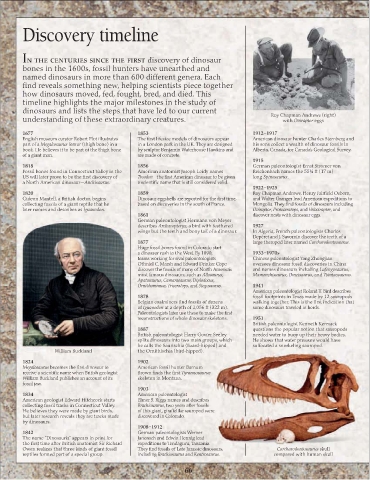
                                                                                           Roy Chapman Andrews (right)
        understanding of these extraordinary creatures.                                        with Oviraptor eggs

        1677                                   1853                                      ʛ
        English museum curator Robert Plot illustrates   The first lifesize models of dinosaurs appear    American dinosaur hunter Charles Sternberg and
        part of a Megalosaurus femur (thigh bone) in a   in a London park in the UK. They are designed    his sons collect a wealth of dinosaur fossils in
        book. He believes it to be part of the thigh bone   by sculptor Benjamin Waterhouse Hawkins and   Alberta, Canada, for Canada’s Geological Survey.
        of a giant man.                        are made of concrete.
                                                                                     1915
        1818                                   1856                                  German paleontologist Ernst Stromer von
        Fossil bones found in Connecticut Valley in the   American anatomist Joseph Leidy names    Reichenbach names the 55¾ ft (17 m)
        US will later prove to be the first discovery of    Troodon—the first American dinosaur to be given   long Spinosaurus.
        a North American dinosaur—Anchisaurus.  a scientific name that is still considered valid.
                                                                                         ʛ
        1820                                   1859                                  Roy Chapman Andrews, Henry Fairfield Osborn,
        Gideon Mantell, a British doctor, begins   Dinosaur eggshells are reported for the first time,   and Walter Granger lead American expeditions to
        collecting fossils of a giant reptile that he    based on discoveries in the south of France.  Mongolia. They find fossils of dinosaurs including
        later names and describes as Iguanodon.                                      Oviraptor, Protoceratops, and Velociraptor, and
                                               1861                                  discover nests with dinosaur eggs.
                                               German paleontologist Hermann von Meyer
                                               describes Archaeopteryx, a bird with feathered   1927
                                               wings but the teeth and bony tail of a dinosaur.  In Algeria, French paleontologists Charles
                                                                                     Depéret and J. Savornin discover the teeth of a
                                               1877                                  large theropod later named Carcharodontosaurus.
                                               Huge fossil bones found in Colorado start
                                               a dinosaur rush to the West. By 1890,        ʛ    ƌ
                                               teams working for rival paleontologists    Chinese paleontologist Yang Zhongjian
                                               Othniel C. Marsh and Edward Drinker Cope   oversees dinosaur fossil discoveries in China
                                               discover the fossils of many of North America’s    and names dinosaurs including Lufengosaurus,
                                               most famous dinosaurs, such as Allosaurus,  Mamenchisaurus, Omeisaurus, and Tsintaosaurus.
                                               Apatosaurus, Camarasaurus, Diplodocus,
                                               Ornithomimus, Triceratops, and Stegosaurus.  1941
                                                                                     American paleontologist Roland T. Bird describes
                                               1878                                  fossil footprints in Texas made by 12 sauropods
                                               Belgian coalminers find fossils of dozens    walking together. This is the first indication that
                                               of Iguanodon at a depth of 1,056 ft (322 m).   some dinosaurs traveled in herds.
                                               Paleontologists later use these to make the first
                                               reconstructions of whole dinosaur skeletons.  1951
                                                                                     British paleontologist Kenneth Kermack
                                               1887                                  questions the popular notion that sauropods
                                               British paleontologist Harry Govier Seeley    needed water to buoy up their heavy bodies.
                                               splits dinosaurs into two main groups, which    He shows that water pressure would have
                                               he calls the Saurischia (lizard-hipped) and    suffocated a snorkeling sauropod.
                   William Buckland            the Ornithischia (bird-hipped).
         1824                                  1902
         Megalosaurus becomes the first dinosaur to   American fossil hunter Barnum
         receive a scientific name when British geologist   Brown finds the first Tyrannosaurus
         William Buckland publishes an account of its   skeleton in Montana.
         fossil jaw.
                                               1903
         1834                                  American paleontologist
         American geologist Edward Hitchcock starts   Elmer S. Riggs names and describes
         collecting fossil tracks in Connecticut Valley.    Brachiosaurus, two years after fossils
         He believes they were made by giant birds,    of this giant, giraffelike sauropod were
         but later research reveals they are tracks made   discovered in Colorado.
         by dinosaurs.
                                                   ʛ
         1842                                  German paleontologists Werner
         The name “Dinosauria” appears in print for    Janensch and Edwin Hennig lead
         the first time after British anatomist Sir Richard   expeditions to Tendaguru, Tanzania.
         Owen realizes that three kinds of giant fossil   They find fossils of Late Jurassic dinosaurs,   Carcharodontosaurus skull
         reptiles formed part of a special group.   including Brachiosaurus and Kentrosaurus.  compared with human skull

                                                              66

