


Page 73 - Dinosaur (DK Eyewitness Books)
P. 73
MANIRAPTORANS (“grasping hands”)      PLESIOSAURS
      A group of theropod dinosaurs with long arms   A group of large marine reptiles living in the
      and hands, including dromaeosaurids such as   Mesozoic Era, with flipper-shaped limbs and,
      Velociraptor, and birds.              often, a long neck.
      MESOZOIC (“middle life”)              PREDATOR
      The geological era, about 250–65 million years   An animal or plant that preys on animals for food.
      ago, containing the Triassic, Jurassic, and
      Cretaceous periods. From the late Triassic    PROSAUROPODS (“before sauropods”)
      on, dinosaurs were the dominant land    A group of early plant-eating saurischians that
      animals in the Mesozoic.              lived from late in the Triassic Period to early in
                                            the Jurassic Period.
      MOLLUSKS
      Snails, clams, squid, and their relatives.   PSITTACOSAURS (“parrot lizards“)
      Ammonites belonged with the squid and their   Bipedal ceratopsians living in the Cretaceous
      kin in a group of mollusks called cephalopods.  Period. Psittacosaurs had deep beaks like those
                                            of parrots and used them to eat plants.
      MOSASAURS
      Large aquatic lizards with paddle-shaped limbs   PTEROSAURS (“winged lizards”)
      and a tail flattened from side to side. They   Flying reptiles of the Mesozoic Era, related
      hunted fish and other sea creatures in the   to the dinosaurs.
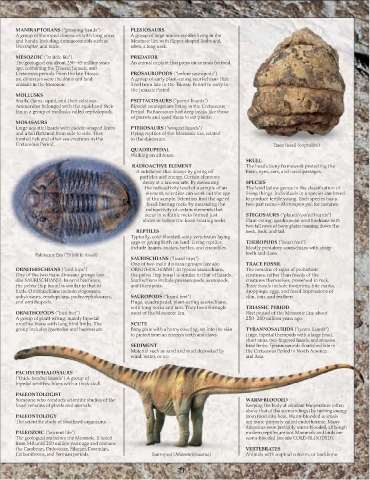
      Cretaceous Period.                                                                   Trace fossil (coprolite)
                                            QUADRUPEDAL
                                            Walking on all fours.
                                                                                  SKULL
                                             RADIOACTIVE ELEMENT                  The head’s bony framework protecting the
                                              A substance that decays by giving off   brain, eyes, ears, and nasal passages.
                                               particles and energy. Certain elements
                                                decay at a known rate. By measuring    SPECIES
                                                 the radioactivity level of a sample of an   The level below genus in the classification of
                                                 element, scientists can work out the age   living things. Individuals in a species can breed
                                                 of the sample. Scientists find the age of   to produce fertile young. Each species has a
                                                 fossil-bearing rocks by measuring the   two-part name—Microraptor gui, for instance.
                                                 radioactivity of certain elements that
                                                 occur in volcanic rocks formed just    STEGOSAURS (“plated/roofed lizards“)
                                                above or below the fossil-bearing rocks.  Plant-eating, quadrupedal ornithischians with
                                                                                  two tall rows of bony plates running down the
                                              REPTILES                            neck, back, and tail.
                                             Typically, cold-blooded, scaly vertebrates laying
                                            eggs or giving birth on land. Living reptiles   THEROPODS (“beast feet”)
                                            include lizards, snakes, turtles, and crocodiles.  Mostly predatory saurischians with sharp
                                                                                  teeth and claws.
             Paleozoic Era (Trilobite fossil)
                                            SAURISCHIANS (“lizard hips”)
                                            One of two main dinosaur groups (see also  TRACE FOSSIL
      ORNITHISCHIANS (“bird hips”)          ORNITHISCHIANS). In typical saurischians,   The remains of signs of prehistoric
      One of the two main dinosaur groups (see  the pelvis (hip bone) is similar to that of lizards.   creatures, rather than fossils of the
      also SAURISCHIANS). In ornithischians,   Saurischians include prosauropods, sauropods,   creatures themselves, preserved in rock.
      the pelvis (hip bone) is similar to that of    and theropods.               Trace fossils include footprints, bite marks,
      birds. Ornithischians include stegosaurs,                                   droppings, eggs, and fossil impressions of
      ankylosaurs, ceratopsians, pachycephalosaurs,   SAUROPODS (“lizard feet”)   skin, hair, and feathers.
      and ornithopods.                      Huge, quadrupedal, plant-eating saurischians,
                                            with long necks and tails. They lived through   TRIASSIC PERIOD
      ORNITHOPODS (“bird feet”)             most of the Mesozoic Era.             First period of the Mesozoic Era; about
      A group of plant-eating, mainly bipedal                                     250–200 million years ago.
      ornithischians with long hind limbs. The    SCUTE
      group includes Iguanodon and hadrosaurs.  Bony plate with a horny covering, set into the skin   TYRANNOSAURIDS (“tyrant lizards”)
                                            to protect from an enemy’s teeth and claws.  Huge, bipedal theropods with a large head,
                                                                                  short arms, two-fingered hands, and massive
                                            SEDIMENT                              hind limbs. Tyrannosaurids flourished late in
                                            Material such as sand and mud deposited by   the Cretaceous Period in North America
                                            wind, water, or ice.                  and Asia.

      PACHYCEPHALOSAURS
      (“thick-headed lizards”) A group of
      bipedal ornithischians with a thick skull.
      PALEONTOLOGIST
      Someone who conducts scientific studies of the                              :$50͆%/22'('
      fossil remains of plants and animals.                                       Keeping the body at constant temperature (often
                                                                                  above that of the surroundings) by turning energy
      PALEONTOLOGY                                                                from food into heat. Warm-blooded animals
      The scientific study of fossilized organisms.                               are more properly called endothermic. Many
                                                                                  dinosaurs were probably warm-blooded, although
      PALEOZOIC (“ancient life”)                                                  modern reptiles are not. Mammals and birds are
      The geological era before the Mesozoic. It lasted                           warm-blooded (see also COLD-BLOODED).
      from 540 until 250 million years ago and contains
      the Cambrian, Ordovician, Silurian, Devonian,                               9(57(%5$7(6
      Carboniferous, and Permian periods.          Sauropod (Mamenchisaurus)      Animals with a spinal column, or backbone.

                                                            71

