


Page 69 - Dinosaur (DK Eyewitness Books)
P. 69
1954                                  1984
      Russian paleontologist Evgeny Maleev discovers   British paleontologist Michael Benton
      the enormously long claws of Therizinosaurus,  coins the name “Dinosauromorpha”
      later found to be one of a strange group of    for the group of reptiles consisting of
      plant-eating theropods called therizinosaurs.  dinosaurs and their closest relatives.
      1965                                  1986
      British paleontologist Alan Charig figures out   British paleontologists Alan Charig and Angela
      how dinosaurs, with their upright stance and   Milner describe Baryonyx, a fish-eating theropod
      gait, evolved from sprawling reptiles.  found in southern England and later identified as
                                            a relative of Spinosaurus.                      Sinosauropteryx
      1969
      American paleontologist John Ostrom    1991
      argues that dinosaurs’ erect limbs meant    American paleontologist William Hammer   American paleontologists Raymond Rogers,
      that they were active, warm-blooded animals.    excavates Cryolophosaurus. This crested theropod   David Krause, and Kristina Curry Rogers show
      He claims that birds evolved from small   will become the first Antarctic dinosaur to be   that the big Madagascan theropod Majungatholus
      theropods. Ostrom bases these claims    named and described in a scientific paper, in 1994.  ate others of its kind. This is the first undisputed
      largely on his discovery in 1964 of the                                     proof that some dinosaurs were cannibals.
      agile theropod Deinonychus.           1993
                                            Argentinian paleontologists José Bonaparte and   2005
      1971                                  Jaimé Powell describe the immense sauropod   Chinese paleontologists Meng Jin and Wang
      A Polish-Mongolian expedition in Mongolia   Argentinosaurus, possibly the largest dinosaur ever.  Yuanqing show that some mammals ate
      finds skeletons of a Velociraptor and Protoceratops                         baby dinosaurs. They found fossils of a
      locked in battle.                     American paleontologist Paul Sereno describes   baby psittacosaur inside a fossil specimen
                                            Eoraptor, the earliest dinosaur to be discovered   of Repenomamus robustus, an opossum-sized
      1972                                  so far.                               mammal that lived in Early Cretaceous China.
      American paleontologist Robert Bakker suggests
      that air sacs in some dinosaurs reveal that these   Jurassic Park’s animatronics and computer   Swedish scientist Caroline Strömberg shows that
      must have had a breathing system like that of   simulations set new standards for the lifelike   some sauropods fed on grass in Late Cretaceous
      birds. Later research supports this idea, at least    depiction of dinosaurs in films.  India. Before this, people thought that no grass
      for saurischian (lizard-hipped) dinosaurs.                                  existed in the Age of Dinosaurs.
                                            1995
      1974                                  Argentinian paleontologists Rodolfo Coria and   2007
      Paleontologists Peter                  Leonardo Salgado describe Giganotosaurus, a   American and Japanese paleontologists report
      Galton and Robert                       theropod perhaps larger than Tyrannosaurus.  the first real evidence that some dinosaurs lived
      Bakker publish a                                                            in burrows. They found fossils of an ornithopod
      paper where                               1998                              in an underground den. Known as Oryctodromeus
      they argue                                Chinese paleontologists Chen Pei-ji,    (“digging runner”), this ornithopod lived in
      that birds are                             Dong Zhi-ming, and Zhen Shuo-nan   Montana, late in the Cretaceous Period.
      dinosaurs.                                 name Sinosauropteryx, the first known
      Subsequent                                 dinosaur with skin covered in downy   2008
      research                                   “dinofuzz” rather than reptilian scales.   Belgian paleontologist Pascal Godefroit and
      provides                                   The discovery supports the theory that   colleagues show that late in the Cretaceous
      strong                                     birds evolved from theropods.    Period, ornithischian (bird-hipped) dinosaurs
      support for                                                                 and theropods not only lived but also bred in
      their claim.                              American paleontologist Karen     Arctic Siberia.
                                                Chin describes tyrannosaur fossil
                                               dung containing bones from a horned   2009
      Robert Bakker                            dinosaur’s skull.                  Mary Schweitzer and colleagues at North
                                                                                  Carolina State University describe the oldest
                                            2003                                  known protein (body molecule), from an
                                            Six Chinese paleontologists describe   80-million-year-old hadrosaur’s thigh bone.
      1978                                  Microraptor gui, a small theropod with   Protein analysis confirms that ornithischian
      In Montana, American paleontologists John   feathered arms and legs that helped it    dinosaurs were more closely related to living
      “Jack” Horner and Robert Makela begin   to glide from tree to tree.            birds than to alligators.
      excavations of fossil hadrosaur nests, eggs,
      and young. They find the first evidence that
      dinosaurs cared for their young.
      1979
      American geologist Walter Alvarez and his
      nuclear physicist father Luis Alvarez establish
      that a large asteroid smashed into Earth at the
      end of the Cretaceous Period with devastating
      effects. This was perhaps responsible for killing
      off all dinosaurs except the birds.
      1980
      American paleontologist Ralph Molnar
      describes the first dinosaur discovery from
      New Zealand—a theropod bone found by
      amateur fossil hunter Joan Wiffen.
      1981
      Australian paleontologist Alan Bartholomai
      and American paleontologist Ralph Molnar
      describe the ornithopod Muttaburrasaurus
      from the first nearly complete dinosaur
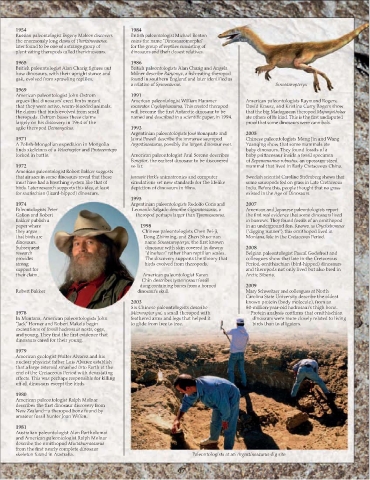
      skeleton found in Australia.                               Paleontologists at an Argentinosaurus dig site

                                                            67

