


Page 38 - BBC Music (January 2020)
P. 38
Les Six


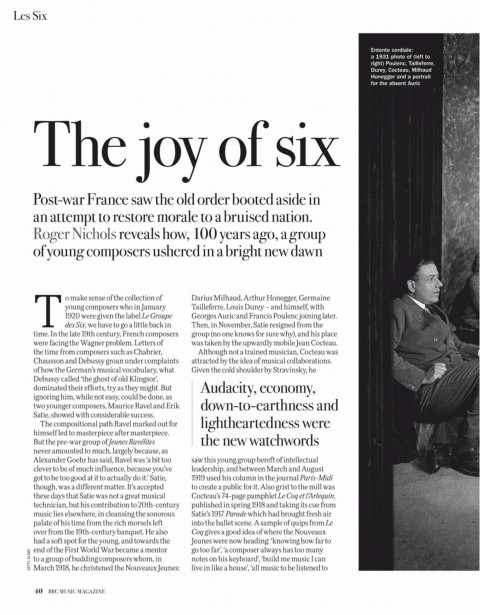
                                                                                                                                  Entente cordiale:
                                                                                                                                  a 1931 photo of (left to
                                                                                                                                  right) Poulenc, Tailleferre,
                                                                                                                                  Durey, Cocteau, Milhaud
                                                                                                                                  Honegger and a portrait
                                                                                                                                  for the absent Auric


            The joy of six


            Post-war France saw the old order booted aside in


            an attempt to restore morale to a bruised nation.


            Roger Nichols reveals how, 100 years ago, a group

            of young composers ushered in a bright new dawn


                        o make sense of the collection of           Darius Milhaud, Arthur Honegger, Germaine
                        young composers who in January              Tailleferre, Louis Durey – and himself, with
                        1920 were given the label Le Groupe         Georges Auric and Francis Poulenc joining later.
             T des Six, we have to go a little back in              Then, in November, Satie resigned from the
             time. In the late 19th century, French composers       group (no one knows for sure why), and his place
             were facing the Wagner problem. Letters of             was taken by the upwardly mobile Jean Cocteau.
             the time from composers such as Chabrier,                Although not a trained musician, Cocteau was
             Chausson and Debussy groan under complaints            attracted by the idea of musical collaborations.
             of how the German’s musical vocabulary, what           Given the cold shoulder by Stravinsky, he
             Debussy called ‘the ghost of old Klingsor’,
             dominated their efforts, try as they might. But           Audacity, economy,
             ignoring him, while not easy, could be done, as
             two younger composers, Maurice Ravel and Erik             down-to-earthness and
             Satie, showed with considerable success.
               The compositional path Ravel marked out for             lightheartedness were
             himself led to masterpiece after masterpiece.
             But the pre-war group of Jeunes Ravélites                 the new watchwords
             never amounted to much, largely because, as
             Alexander Goehr has said, Ravel was ‘a bit too         saw this young group bereft of intellectual
             clever to be of much influence, because you’ve         leadership, and between March and August
             got to be too good at it to actually do it.’ Satie,    1919 used his column in the journal Paris-Midi
             though, was a different matter. It’s accepted          to create a public for it. Also grist to the mill was
             these days that Satie was not a great musical          Cocteau’s 74-page pamphlet Le Coq et l’Arlequin,
             technician, but his contribution to 20th-century       published in spring 1918 and taking its cue from
             music lies elsewhere, in cleansing the sonorous        Satie’s 1917 Parade which had brought fresh air
             palate of his time from the rich morsels left          into the ballet scene. A sample of quips from Le
             over from the 19th-century banquet. He also            Coq gives a good idea of where the Nouveaux
             had a soft spot for the young, and towards the         Jeunes were now heading: ‘knowing how far to
                                                                    go too far’, ‘a composer always has too many
             end of the First World War became a mentor
           GETTY, ALAMY  to a group of budding composers whom, in   notes on his keyboard’, ‘build me music I can
                                                                    live in like a house’, ‘all music to be listened to
             March 1918, he christened the Nouveaux Jeunes:


             40   BBC MUSIC MAGAZINE

