


Page 40 - BBC Music (January 2020)
P. 40
Les Six


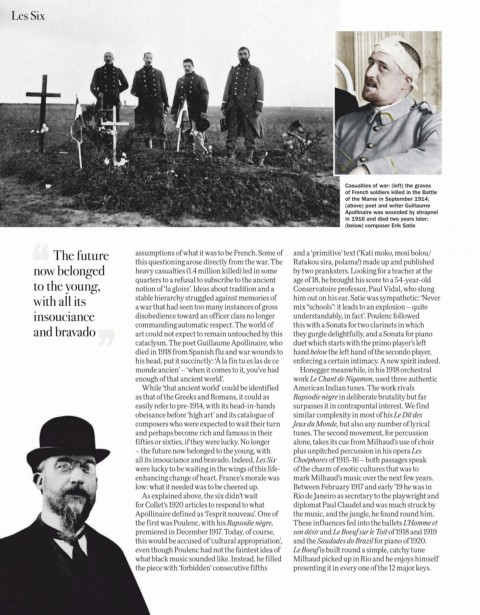
                                                                                                                         Casualties of war: (left) the graves
                                                                                                                         of French soldiers killed in the Battle
                                                                                                                         of the Marne in September 1914;
                                                                                                                         (above) poet and writer Guillaume
                                                                                                                         Apollinaire was wounded by shrapnel
                                                                                                                         in 1916 and died two years later;
                                                                                                                         (below) composer Erik Satie


           ‘‘      The future                   assumptions of what it was to be French. Some of       and a ‘primitive’ text (‘Kati moko, mosi bolou/

                                                this questioning arose directly from the war. The
                                                                                                       Ratakou sira, polama!) made up and published
             now belonged
                                                                                                       by two pranksters. Looking for a teacher at the
                                                heavy casualties (1.4 million killed) led in some
             to the young,                      quarters to a refusal to subscribe to the ancient      age of 18, he brought his score to a 54-year-old
                                                notion of ‘la gloire’. Ideas about tradition and a
                                                                                                       Conservatoire professor, Paul Vidal, who slung
             with all its                       stable hierarchy struggled against memories of         him out on his ear. Satie was sympathetic: ‘Never
                                                                                                       mix “schools”: it leads to an explosion – quite
                                                a war that had seen too many instances of gross
             insouciance                        disobedience toward an officer class no longer         understandably, in fact’. Poulenc followed
                                                commanding automatic respect. The world of             this with a Sonata for two clarinets in which
             and bravado                        art could not expect to remain untouched by this       they gurgle delightfully, and a Sonata for piano
                                  ’’            cataclysm. The poet Guillaume Apollinaire, who         duet which starts with the primo player’s left


                                                died in 1918 from Spanish flu and war wounds to
                                                                                                       hand below the left hand of the secondo player,
                                                his head, put it succinctly: ‘À la fin tu es las de ce
                                                monde ancien’ – ‘when it comes to it, you’ve had       enforcing a certain intimacy. A new spirit indeed.
                                                                                                         Honegger meanwhile, in his 1918 orchestral
                                                enough of that ancient world’.                         work Le Chant de Nigamon, used three authentic
                                                  While ‘that ancient world’ could be identified       American Indian tunes. The work rivals
                                                as that of the Greeks and Romans, it could as          Rapsodie nègre in deliberate brutality but far
                                                easily refer to pre-1914, with its head-in-hands       surpasses it in contrapuntal interest. We find
                                                obeisance before ‘high art’ and its catalogue of       similar complexity in most of his Le Dit des
                                                composers who were expected to wait their turn         Jeux du Monde, but also any number of lyrical
                                                and perhaps become rich and famous in their            tunes. The second movement, for percussion
                                                fifties or sixties, if they were lucky. No longer      alone, takes its cue from Milhaud’s use of choir
                                                – the future now belonged to the young, with           plus unpitched percussion in his opera Les
                                                all its insouciance and bravado. Indeed, Les Six       Choéphores of 1915-16 – both passages speak
                                                were lucky to be waiting in the wings of this life-    of the charm of exotic cultures that was to
                                                enhancing change of heart. France’s morale was         mark Milhaud’s music over the next few years.
                                                low: what it needed was to be cheered up.              Between February 1917 and early ’19 he was in
                                                  As explained above, the six didn’t wait              Rio de Janeiro as secretary to the playwright and
                                                for Collet’s 1920 articles to respond to what          diplomat Paul Claudel and was much struck by
                                                Apollinaire defined as ‘l’esprit nouveau’. One of      the music, and the jungle, he found round him.
                                                the first was Poulenc, with his Rapsodie nègre,        These influences fed into the ballets L’Homme et
                                                premiered in December 1917. Today, of course,          son désir and Le Boeuf sur le Toit of 1918 and 1919
                                                this would be accused of ‘cultural appropriation’,     and the Saudades do Brazil for piano of 1920.
                                                even though Poulenc had not the faintest idea of       Le Boeuf is built round a simple, catchy tune
                                                what black music sounded like. Instead, he filled      Milhaud picked up in Rio and he enjoys himself
                                                the piece with ‘forbidden’ consecutive fifths          presenting it in every one of the 12 major keys.

