


Page 42 - BBC Music (January 2020)
P. 42
The English organ


            Windsofchange


            Over the centuries, social upheavals and changing

            musical fashions have both ravaged and transformed


            the English organ. Daniel Moult tells its story


                             hat does the term ‘English organ’      of stops were all that was required to accompany
                             conjure up in your mind? Rich          or play alongside the choir. It could simply be
                             sounds in a generous acoustic,         that they were not perceived as impressive
             W underpinning a cathedral choir?                      enough to be saved from zealous Reformers.
             The pomp and ceremony of a royal occasion                In 1977, a man renovating his farmhouse in
             or the Last Night of the Proms? Or maybe just          Wetheringsett, Suffolk, was intrigued by a piece
             background muzak to a church service or                of timber that had served as a door in centuries
             civic event: sometimes saccharine, sometimes           gone by. Why did it have rows of grooves and
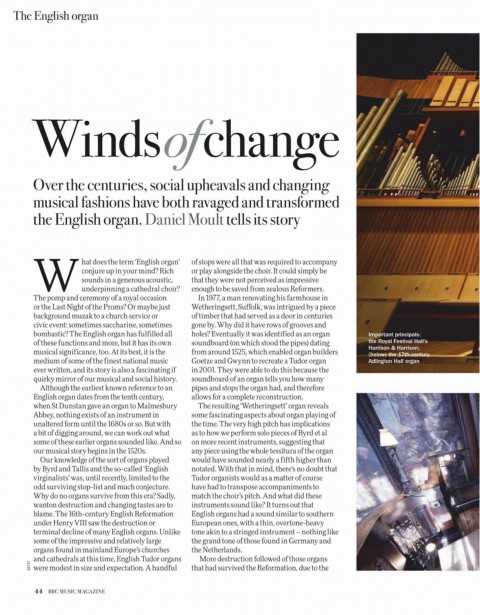
             bombastic? The English organ has fulfilled all         holes? Eventually it was identified as an organ              Important principals:
             of these functions and more, but it has its own        soundboard (on which stood the pipes) dating                 the Royal Festival Hall’s
                                                                                                                                 Harrison & Harrison;
             musical significance, too. At its best, it is the      from around 1525, which enabled organ builders               (below) the 17th-century
             medium of some of the finest national music            Goetze and Gwynn to recreate a Tudor organ                   Adlington Hall organ
             ever written, and its story is also a fascinating if   in 2001. They were able to do this because the
             quirky mirror of our musical and social history.       soundboard of an organ tells you how many
               Although the earliest known reference to an          pipes and stops the organ had, and therefore
             English organ dates from the tenth century,            allows for a complete reconstruction.
             when St Dunstan gave an organ to Malmesbury              The resulting ‘Wetheringsett’ organ reveals
             Abbey, nothing exists of an instrument in              some fascinating aspects about organ playing of
             unaltered form until the 1680s or so. But with         the time. The very high pitch has implications
             a bit of digging around, we can work out what          as to how we perform solo pieces of Byrd et al
             some of these earlier organs sounded like. And so      on more recent instruments, suggesting that
             our musical story begins in the 1520s.                 any piece using the whole tessitura of the organ
               Our knowledge of the sort of organs played           would have sounded nearly a fifth higher than
             by Byrd and Tallis and the so-called ‘English          notated. With that in mind, there’s no doubt that
             virginalists’ was, until recently, limited to the      Tudor organists would as a matter of course
             odd surviving stop-list and much conjecture.           have had to transpose accompaniments to
             Why do no organs survive from this era? Sadly,         match the choir’s pitch. And what did these
             wanton destruction and changing tastes are to          instruments sound like? It turns out that
             blame. The 16th-century English Reformation            English organs had a sound similar to southern
             under Henry VIII saw the destruction or                European ones, with a thin, overtone-heavy
             terminal decline of many English organs. Unlike        tone akin to a stringed instrument – nothing like
             some of the impressive and relatively large            the grand tone of those found in Germany and
             organs found in mainland Europe’s churches             the Netherlands.
             and cathedrals at this time, English Tudor organs         More destruction followed of those organs
           GETTY  were modest in size and expectation. A handful    that had survived the Reformation, due to the


             44   BBC MUSIC MAGAZINE

