


Page 115 - (DK Eyewitness) Travel Guide - Sydney
P. 115
AR T GALLER Y OF NE W SOUTH W ALES 113
Man Ray, Cindy Sherman
and Yasumasa Morimura are
also represented.
Asian Art
The Gallery houses a remarkable
collection of both historical and
contemporary Asian art, particu-
larly works of East Asia from the
pre-Shang dynasty (c.1600–
1027 BC) to the 20th century. It
is recognized for its fine Chinese
ceramics and Japanese paintings.
There are also excellent holdings
of South and Southeast Asian
art, especially sculptures and Spearing the Kangaroo (c.1880s–90s) by renowned Aboriginal artist Tommy McRae
paintings. Dynamic exhibitions,
held across two dedicated Asian collection, while offering fresh
galleries, change regularly. The Contemporary Art perspectives on both classic
upper gallery is housed within The contemporary galleries pieces and new acquisitions.
a glass pavilion, with the design encompass works in all media
inspired by floating lanterns. by artists from Australia and
across the globe, including Yiribana Gallery
Fiona Hall, Bill Henson, Tracey Yiribana means “this way” in the
Prints and Drawings
Moffatt, Simryn Gill, Anish language of the Eora people, an
Drawings and prints are on Kapoor, Cy Twombly, Louise acknowledgment of the gallery’s
display throughout the Gallery Bourgeois and Ai Weiwei. location on Cadigal Land. Home
in the various collections, as Following the addition of the of the Aboriginal and Torres
well as in the Study Room. They John Kaldor Family Collection, Strait Islander collection, the
rep resent the European tradition which includes works by Yiribana Gallery showcases
from the Renaissance to the Sol LeWitt, Nam June Paik Australia’s enduring Indigenous
19th and 20th centuries, with and Robert Rauschenberg, cultural heritage, from Tommy
works by Rembrandt, Constable, the Gallery now holds McRae’s late 19th-century draw-
William Blake and Edvard Munch. Australia’s most comprehensive ings to works by contemporary
A strong bias towards Sydney representation of art from artists. Traditional bark paintings
artists has result ed in a fine the 1960s to the present hang alongside innovative
gathering of works by Thea day. A series of rotating works from both desert and
Proctor, Norman and Lionel exhibitions reflect the urban areas. The application
Lindsay, and Lloyd Rees. range and richness of this by contemporary artists of
traditional ceremonial body
and sand painting styles to
new media forms, and the
endurance of “Aboriginality”,
are repeatedly demonstrated.
Topographical, geo graphical
and cultural mapping of the
land is displayed in a number
of intricate land scapes. The
qualities and forms of the
natural world, and the actions
and tracks of Ancestral Beings,
are coded within the images.
Tutini (Pukumani grave posts)
(1958) is a solemn ceremonial
work dealing with death, while
Emily Kame Kngwarreye honours
the land from which she comes:
the canvases of her intricate dot
paintings, created using new
tools and technology, appear
to move and shimmer, telling
stories of the animals and food
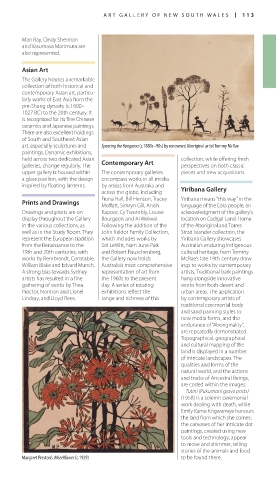
Margaret Preston’s Wheelflower (c.1929) to be found there.
112-113_EW_Sydney.indd 113 29/05/17 12:16 pm

