


Page 70 - (DK Eyewitness) Travel Guide - Sydney
P. 70
68 SY DNEY AREA B Y AREA
1 Campbell’s 2 George Street
Storehouses the 1950s, began its life as the
Map 1 B2. @ Sydney Explorer. Maritime Services Board’s
7–27 Circular Quay West; The Rocks. Circular Quay. administration offices.
Map 1 B2. @ Sydney Explorer, In the early 1970s, union
Circular Quay routes from Elizabeth St. Formerly the preserve of wealthy workers placed “green bans” on
Circular Quay. 7 merchants, sailors and the city’s the demolition of The Rocks
working class, George Street (see p32). These streets had been
In 1798, the Scottish merchant today is a popular attraction con sidered slum areas by the
Robert Campbell sailed into with visitors to Sydney, who government of the day. However,
Sydney Cove and soon are drawn to its restaurants, many of the buildings in George
established himself as a art galleries, museums, jewellery Street were restored and are now
founding father of commerce stores and craft souvenir shops. listed by the National Trust. The
for the new colony. With trade One of Sydney’s original Rocks remains a vibrant part of
links already established in thoroughfares – some say the city, with George Street at its
Calcutta, his business blossomed. Australia’s first street – it ran hub. A market is held here every
In 1839, Campbell began from the main water supply, weekend, when part of the street
constructing a private wharf the Tank Stream, to the tiny is closed off to traffic (see p203).
and stores to house the tea, community in the Rocks, and A new Light Rail line running
sugar, spirits and cloth that he was known as Spring Street. In the length of George Street is
imported from India. Twelve 1810, it was renamed in honour due to open in 2019, aimed at
sandstone bays had been of George III. George Street reducing traffic and returning
built by 1861 and a brick upper today runs from the Harbour the street to its glory days as a
storey was added in about 1890. Bridge to the Central Railway grand pedestrian thoroughfare.
Part of the old sea wall and 11 Station north of Chinatown.
of the original stores still remain. Many 19th-century buildings
The area soon took on the remain, such as the 1844 3 The Rocks
name of Campbell’s Cove, Counting House at No. 43, the Discovery Museum
which it retains to this day. Old Police station at No. 127
Today, the bond stores contain (1882), and the Russell Hotel 2–6 Kendall Lane, The Rocks.
several harbourside restaurants at No. 143 (1887). Map 1 B2. Tel 9240 8680. @ Sydney
catering for a range of tastes, But it is The Rocks end that Explorer, Circular Quay routes from
from contemporary to Chinese most reflects what the early Elizabeth St. Circular Quay. Open
10am–5pm daily. Closed Good Fri, 25
and Italian. It is a delightful area colony must have looked Dec. ∑ therocks.com
in which to relax with a meal like, characterized by cobbled
and watch the bustling boats pave ments, narrow side streets, This museum is in a restored
in the harbour go by. The warehouses, bond stores, pubs 1850s sandstone coach house,
pulleys that were used to raise and shop fronts that reflect the and has exhibitions on the
cargo from the wharf can still area’s maritime history. Even history of The Rocks, including
be seen on the outside, near the Museum of Contemporary displays on its first Aboriginal
the top of the building. Art (see p75), constructed during inhabitants, the Cadigal people,
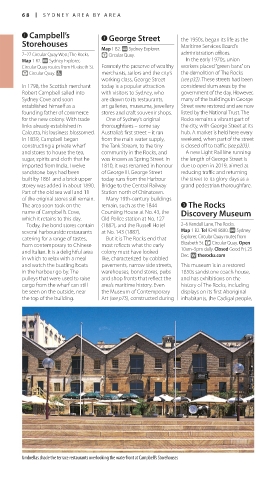
Umbrellas shade the terrace restaurants overlooking the waterfront at Campbell’s Storehouses
068-069_EW_Sydney.indd 68 29/05/17 12:19 pm

