


Page 111 - How It Works - Book Of Amazing Answers To Curious Questions, Volume 05-15
P. 111
Space


            What are the icy scars of Tethys?


            The craters and mysterious marks
            covering the surface of Saturn’s
            battered moon


                 omposed mainly of ice, Tethys orbits
                 Saturn at a distance of around 295,000
            Ckilometres (183,305 miles). It is the fi fth
            largest of all of Saturn’s satellites and has
            two tiny companions, Telesto and Calypso,
            which are both less that 32 kilometres (20
            miles) across, held in place by Tethys’
            gravity. It is merely one of 62 moons
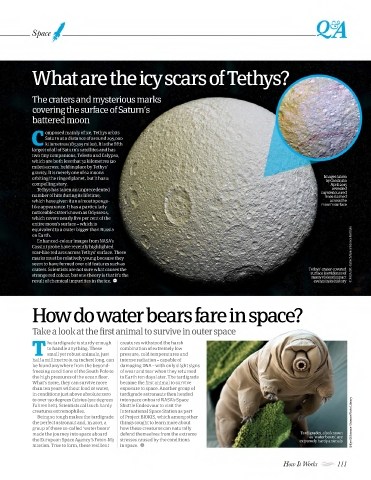
            orbiting the ringed planet, but it has a                                                               Images taken
                                                                                                                   by Cassini in
            compelling story.                                                                                        April 2015
              Tethys has taken an unprecedented                                                                       revealed
            number of hits during its lifetime,                                                                   mysterious red
                                                                                                                   lines slashed
            which have given it an almost sponge-                                                                    across the
            like appearance. It has a particularly                                                                moon’s surface
            noticeable crater known as Odysseus,

            which covers nearly five per cent of the
            entire moon’s surface – which is
            equivalent to a crater bigger than Russia
            on Earth.
              Enhanced-colour images from NASA’s
            Cassini probe have recently highlighted
            scar-like red arcs across Tethys’ surface. These                                                                © NASA/JPL-Caltech/Space Science Institute
            marks must be relatively young because they
            seem to have formed over old features such as
            craters. Scientists are not sure what causes the                                                  Tethys’ crater-covered
                                                                                                              surface is evidence of
            strange red colour, but one theory is that it’s the
                                                                                                              many violent impact
            result of chemical impurities in the ice.                                                          events in its history


            How do water bears fare in space?


            Take a look at the first animal to survive in outer space
                  he tardigrade is sturdy enough   creatures withstood the harsh
                  to handle anything. These   combination of extremely low
            T small yet robust animals, just   pressure, cold temperatures and
            half a millimetre (0.02 inches) long, can   intense radiation – capable of
            be found anywhere from the beyond-  damaging DNA – with only slight signs
            freezing conditions of the South Pole to   of wear and tear when they returned
            the high pressures of the ocean fl oor.   to Earth ten days later. The tardigrade
            What’s more, they can survive more   became the first animal to survive

            than ten years without food or water,   exposure to space. Another group of
            in conditions just above absolute zero   tardigrade astronauts then headed
            to over 150 degrees Celsius (302 degrees   into space onboard NASA’s Space
            Fahrenheit). Scientists call such hardy   Shuttle Endeavour to visit the
            creatures extremophiles.       International Space Station as part
              Being so tough makes the tardigrade   of Project BIOKIS, which among other
            the perfect astronaut and, in 2007, a   things sought to learn more about                                        © Eye Of Science / Science Photo Library
            group of these so-called ‘water bears’   how these creatures can naturally
            made the journey into space aboard   defend themselves from the extreme                        Tardigrades, also known
                                                                                                              as ‘water bears’, are
            the European Space Agency’s Foton-M3   stresses caused by the conditions                      extremely hardy animals
            mission. True to form, these resilient   in space.

                                                                                                     How It Works        111

