


Page 113 - How It Works - Book Of Amazing Answers To Curious Questions, Volume 05-15
P. 113
Space


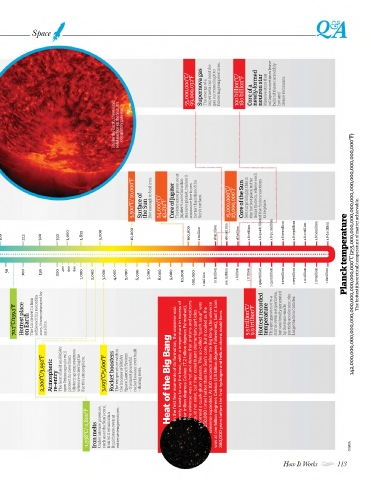
                                                                   55,000,000°C/  99,000,032°F  Supernova gas  The energy of a  supernova can heat the   gas surrounding it to  blistering temperatures.  100 billion°C/  180 billion°F  Core of a   newly-formed   neutron star  Massive stars that  collapse sometimes leave  behind these incredibly   hot and   dense remnants.


                                         Unlike the Earth, there is no  solid surface on the Sun. It’s   completely gaseous


                                                5,500°C/ 10,000°F  Surface of   the Sun  Hot enough to boil iron.  24,000°C/  43,232°F  Core of Jupiter The immense pressure at  Jupiter’s core from this  massive planet, makes it    ve times  a massive fi  hotter than that of the   Sun’s surface.  15,000,000°C/  27,000,000°F  Core of the Sun  Not surprisingly, this is  the hottest place in the  Solar System, where each  of the fusion reactions   take place.


  100     212  300    392  1,000  1,832  5,000  10,000              100,000  1 million  18 million  180 million  18 billion  1.8 trillion  1.8 quadrillion  1.8 quintillion  1.8 sextillion  1.8 septillion  1.8 octillion  1.8 nonillion  1.8 decillion


    50    100   150   200  400  600  800  1,000  2,000  3,000  4,000  5,000  6,000  7,000  8,000  9,000  10,000  100,000  1 million  10 million  100 million  1 billion  1 trillion  1 quadrillion  1 quintillion  1 sextillion  1 septillion  1 octillion  1 nonillion  1 decillion  Planck temperature 142,000,000,000,000,000,000,000,000,000,000°C (255,000,000,000,000,000,000,000,000,000,000°F) The hottest (theoretical) temperature of matter achievable.


      70.7°C/159.3°F  Hottest place   on Earth  The Lut desert in Iran  achieved this record in  2005. It was measured by   satellite.  5.5 trillion°C/  9.9 trillion°F  Hottest recorded   temperature  This gong goes not to a  star or even a supernova,    y generated  but was briefl  by the man-made  particle accelerator, the  Large Hadron Collider.


                2,200°C/3,992°F  Atmospheric   re-entry The heat shield on NASA’s  new Orion capsule will  protect its crew from  blistering temperatures  when re-entering the   Earth’s atmosphere.  3,093°C/5,600°F  Rocket boosters  The temperature within   the booster of NASA’s   Space Launch System   – the most powerful  rocket booster ever built   – during tests.  Heat of the Big Bang In the first few moments of its formation, the universe was  pretty toasty to say the least, with a temperature in excess of  four


                                -1,538°C/-2,800°F  Iron melts  Under intense pressure,  such as at the Sun’s core,  iron will remain in a   liquid state even at  extreme temperatures.     © NASA


                                                                                                     How It Works        113

