


Page 16 - How It Works - Book Of Amazing Answers To Curious Questions, Volume 05-15
P. 16
What are


           asperatus clouds?


           Understand what’s behind the world’s newest cloud formation

                  he last time a new type of cloud   offi cially classified as asperatus clouds,   when ice crystals in the clouds sink, but


                  was officially recognised by the   from the Latin word for ‘roughened’. For   are too large to evaporate in the air below.
           T UN’s World Meteorological          this to happen, the cause of the cloud has   To form an asperatus cloud, strong
            Organization was in 1951, but these choppy   to be identifi ed first. Although their   winds then shear the underside of the

            seas in the sky could be next.      formation is not yet entirely understood,   mammatus cloud to form undulating
             After being unable to identify the clouds   some experts believe they form under the   waves instead of pouches. If they are

            from photos sent in by sky watchers all   same conditions as mammatus clouds,   classified, the clouds will be included in
            over the world, the Cloud Appreciation   which look as though they have a series of   the International Cloud Atlas, which has
            Society has proposed that they should be   pouches hanging below them. These occur   not been published since 1975.


          Why is it hotter in cities?


          The effect that causes rising urban temperatures

             t’s not just busy public transport   of sunlight during the day. The stored
             that makes city life feel sweatier   energy is given off as heat, warming the
         I than rural areas. On average,   area by as much as 12 degrees Celsius (22
          densely populated cities are one to three   degrees Fahrenheit). Cities also have
          degrees Celsius (1.8 to 5.4 degrees   less vegetation than the countryside,
          Fahrenheit) warmer than their    meaning plants can’t help to cool the air
          surroundings, resulting in a     by using the excess heat to evaporate the
          phenomenon known as the urban heat   water they absorb.  Use of cars and air
          island effect. Dark surfaces of urban   conditioning also increases
          buildings and asphalt roads absorb lots   temperatures in urban areas.
              Dark surfaces of urban buildings
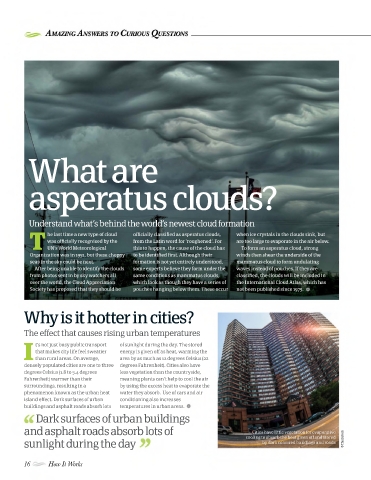
          and asphalt roads absorb lots of                                                Cities have little vegetation for evaporative
                                                                                       cooling to absorb the heat given off and stored   © Thinkstock
          sunlight during the day                                                            by dark coloured buildings and roads


          16       How It Works

