


Page 18 - How It Works - Book Of Amazing Answers To Curious Questions, Volume 05-15
P. 18
Why is Lake Natron


         so           inhospitable?


          Understand the natural phenomenon behind
          Tanzania’s this colourful – and super salty – soda lake


              ituated in Africa’s Great Rift   was originally a much larger
              Valley, Lake Natron’s bright   freshwater lake, but as the hot, dry
         S pink waters stand out in    climate evaporated much of the
         more ways than one. In addition to   water, it shrank and became very
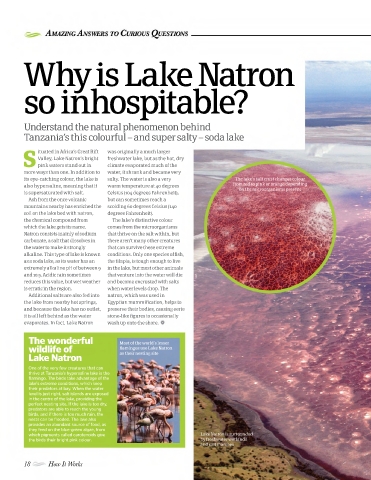
         its eye-catching colour, the lake is   salty. The water is also a very     The lake’s salt crust changes colour
         also hypersaline, meaning that it   warm temperature at 40 degrees        from red to pink or orange depending
                                                                                     on the microorganisms present
         is supersaturated with salt.   Celsius (104 degrees Fahrenheit),
           Ash from the once volcanic   but can sometimes reach a
         mountains nearby has enriched the   scolding 60 degrees Celsius (140
         soil on the lake bed with natron,   degrees Fahrenheit).
         the chemical compound from      The lake’s distinctive colour
         which the lake gets its name.   comes from the microorganisms
         Natron consists mainly of sodium   that thrive on the salt within, but
         carbonate, a salt that dissolves in   there aren’t many other creatures
         the water to make it strongly   that can survive these extreme
         alkaline. This type of lake is known   conditions. Only one species of fish,
         as a soda lake, as its water has an   the tilapia, is tough enough to live
         extremely alkaline pH of between 9   in the lake, but most other animals
         and 10.5. Acidic rain sometimes   that venture into the water will die
         reduces this value, but wet weather   and become encrusted with salts
         is erratic in the region.     when water levels drop. The
           Additional salts are also fed into   natron, which was used in
         the lake from nearby hot springs,   Egyptian mummification, helps to
         and because the lake has no outlet,   preserve their bodies, causing eerie
         it is all left behind as the water   stone-like figures to occasionally
         evaporates. In fact, Lake Natron   wash up onto the shore.


           The wonderful                   Most of the world’s lesser
           wildlife of                     flamingos use Lake Natron
           Lake Natron                     as their nesting site
           One of the very few creatures that can
           thrive at Tanzania’s hypersaline lake is the
           flamingo. The birds take advantage of the
           lake’s extreme conditions, which keep
           their predators at bay. When the water
           level is just right, salt islands are exposed
           in the centre of the lake, providing the
           perfect nesting site. If the lake is too dry,
           predators are able to reach the young
           birds, and if there is too much rain, the
           nests can be flooded. The lake also
           provides an abundant source of food, as
           they feed on the blue-green algae, from
           which pigments called carotenoids give                      Lake Natron is surrounded
           the birds their bright pink colour.                         by freshwater wetlands
                                                                       and salt marshes


          18       How It Works

