


Page 21 - How It Works - Book Of Amazing Answers To Curious Questions, Volume 05-15
P. 21
Environment


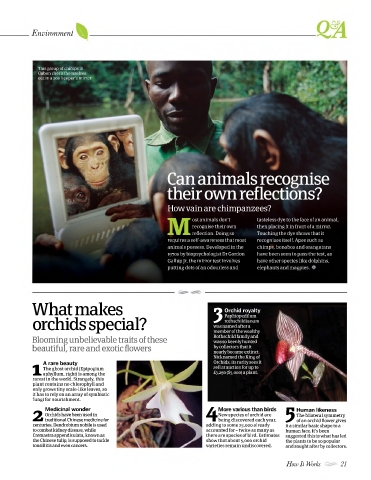
              This group of chimps in
              Gabon check themselves
              out in a zoo keeper’s mirror


                                                            Can animals recognise

                                                            their own reflections?


                                                            How vain are chimpanzees?

                                                                     ost animals don’t     tasteless dye to the face of an animal,
                                                                     recognise their own   then placing it in front of a mirror.
                                                            M refl ection. Doing so         Touching the dye shows that it
                                                            requires a self-awareness that most   recognises itself. Apes such as
                                                            animals possess. Developed in the   chimps, bonobos and orangutans
                                                            1970s by biopsychologist Dr Gordon   have been seen to pass the test, as
                                                            Gallup Jr, the mirror test involves   have other species like dolphins,
                                                            putting dots of an odourless and   elephants and magpies.


            What makes                                                      3   Orchid royalty

                                                                                Paphiopedilum
            orchids special?                                                was named after a
                                                                                 rothschildianum
                                                                            member of the wealthy
            Blooming unbelievable traits of these                           Rothschild family and
                                                                            was so keenly hunted
            beautiful, rare and exotic fl      owers                         by collectors that it
                                                                            nearly became extinct.
                                                                            Nicknamed the King of
                A rare beauty                                               Orchids, its rarity sees it
                The ghost orchid (Epipogium                                 sell at auction for up to
                a
            1 phyllum, right) is among the                                  £3,250 ($5,000) a plant.
             rarest in the world. Strangely, this
             plant contains no chlorophyll and
             only grows tiny scale-like leaves, so
             it has to rely on an array of symbiotic
             fungi for nourishment.
                 Medicinal wonder                                             More various than birds  5  Human likeness
                 Orchids have been used in                               4 New species of orchid are     The bilateral symmetry
                 t
                 r
            2 aditional Chinese medicine for                                   being discovered each year,    of an orchid fl ower gives
             centuries. Dendrobium nobile is used                        adding to some 25,000 already   it a similar basic shape to a
             to combat kidney disease, while                             accounted for – twice as many as   human face. It’s been
             Cremastra appendiculata, known as                           there are species of bird. Estimates   suggested this is what has led
             the Chinese tulip, is supposed to tackle                    show that about 5,000 orchid   the plants to be so popular
             tonsillitis and even cancers.                               varieties remain undiscovered.  and sought after by collectors.
                                                                                                      How It Works        21

