


Page 175 - How It Works - Book Of Amazing Answers To Curious Questions, Volume 05-15
P. 175
History


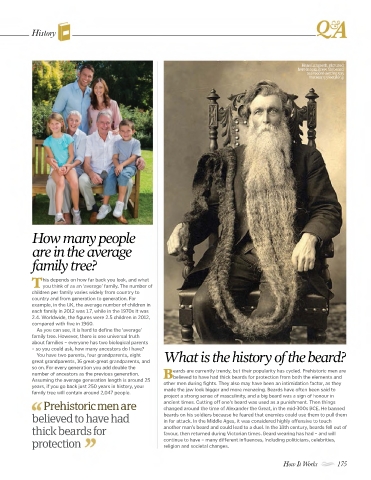
                                                                                                           Hans Langseth, pictured
                                                                                                          here in 1912, grew his beard
                                                                                                             to a record-setting 5.33
                                                                                                              metres (17.5 feet) long


            How many people

            are in the average

            family tree?


                his depends on how far back you look, and what
            Tyou think of as an ‘average’ family. The number of
            children per family varies widely from country to
            country and from generation to generation. For
            example, in the UK, the average number of children in
            each family in 2012 was 1.7, while in the 1970s it was
            2.4. Worldwide, the figures were 2.5 children in 2012,


            compared with five in 1960.

              As you can see, it is hard to define the ‘average’
            family tree. However, there is one universal truth
            about families – everyone has two biological parents
            – so you could ask, how many ancestors do I have?
            great grandparents, 16 great-great grandparents, and  What is the history of the beard?
              You have two parents, four grandparents, eight
            so on. For every generation you add double the    eards are currently trendy, but their popularity has cycled. Prehistoric men are
            number of ancestors as the previous generation.   Bbelieved to have had thick beards for protection from both the elements and
            Assuming the average generation length is around 25   other men during fights. They also may have been an intimidation factor, as they

            years, if you go back just 250 years in history, your   made the jaw look bigger and more menacing. Beards have often been said to
            family tree will contain around 2,047 people.
                                                           project a strong sense of masculinity, and a big beard was a sign of honour in
                                       e

                                   m
                                              r
                                               e
                                           a
                                        n

                                 c
                   r
                    e
                      h

                 Prehistoric men are                       ancient times. Cutting off one’s beard was used as a punishment. Then things
                P
                            o
                              r
                                i
                        i
                          s
                           t
                                                           changed around the time of Alexander the Great, in the mid-300s BCE. He banned
            believed to have had                           beards on his soldiers because he feared that enemies could use them to pull them
                                                           in for attack. In the Middle Ages, it was considered highly offensive to touch
            thick beards for                               another man’s beard and could lead to a duel. In the 18th century, beards fell out of
                                                           favour, then returned during Victorian times. Beard wearing has had – and will

            protection                                     continue to have – many different influences, including politicians, celebrities,
                                                           religion and societal changes.
                                                                                                     How It Works        175

