


Page 174 - How It Works - Book Of Amazing Answers To Curious Questions, Volume 05-15
P. 174
Why were

                                                                                              the names of

                                                                                              the planets

                                                                                              chosen?


                                                                                                  lanetary names in our Solar
                                                                                              PSystem are derived from
                                                                                              mythology – except for Earth,
                                                                                              which comes from Middle
                                                                                              English. Since five of the planets
                                                                                              can be seen by the naked eye,
                                                                                              they have been called many
                                                                                              things depending on the culture
                                                                                              over the centuries before their
                                                                                              current names became standard.
                                                                                              Uranus (previously thought to
                                                                                              have been a star) is the only
                                                                                              planet whose name comes from
                                                                                              Greek rather than Roman
                                                                                              mythology. Neptune’s
                                                                                              discoverers argued over who
                                                                                              could name it, while former
                                                                                              planet Pluto’s name was
                                                                                              suggested by an 11-year-old in
                                                                                              the UK. There were no planetary
                                                                                              naming rules until 1919, when
                                                                                              the International Astronomical
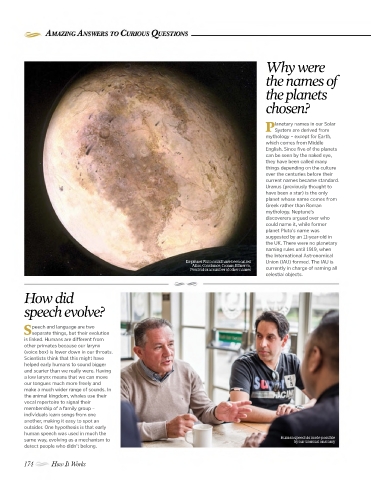
                                                                  Ex-planet Pluto could have been called   Union (IAU) formed. The IAU is
                                                                     Atlas, Constance, Cronus, Minerva,
                                                                    Percival or a number of other names  currently in charge of naming all
                                                                                              celestial objects.


          How did

          speech evolve?


            peech and language are two
         Sseparate things, but their evolution
          is linked. Humans are different from
          other primates because our larynx
          (voice box) is lower down in our throats.
          Scientists think that this might have
          helped early humans to sound bigger
          and scarier than we really were. Having
          a low larynx means that we can move
          our tongues much more freely and
          make a much wider range of sounds. In
          the animal kingdom, whales use their
          vocal repertoire to signal their
          membership of a family group –
          individuals learn songs from one
          another, making it easy to spot an
          outsider. One hypothesis is that early
          human speech was used in much the
          same way, evolving as a mechanism to                                                      Human speech is made possible
                                                                                                        by our unusual anatomy
          detect people who didn’t belong.

          174       How It Works

