


Page 172 - How It Works - Book Of Amazing Answers To Curious Questions, Volume 05-15
P. 172
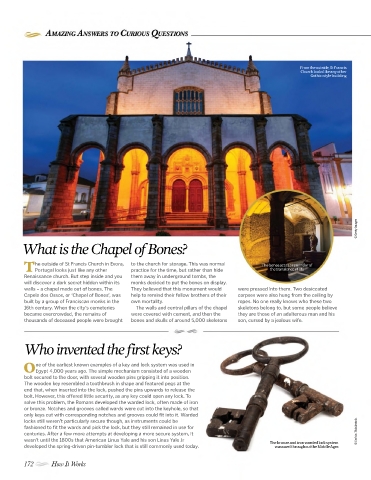
From the outside, St Francis
                                                                                                           Church looks like any other
                                                                                                              Gothic-style building


                                                                                                                              © Getty Images


         What is the Chapel of Bones?


             he outside of St Francis Church in Evora,   to the church for storage. This was normal   The bones act as a reminder of
         TPortugal looks just like any other   practice for the time, but rather than hide      the transience of life
          Renaissance church. But step inside and you   them away in underground tombs, the
          will discover a dark secret hidden within its   monks decided to put the bones on display.
          walls – a chapel made out of bones. The   They believed that this monument would   were pressed into them. Two desiccated
          Capela dos Ossos, or ‘Chapel of Bones’, was   help to remind their fellow brothers of their   corpses were also hung from the ceiling by
          built by a group of Franciscan monks in the   own mortality.               ropes. No one really knows who these two
          16th century. When the city’s cemeteries   The walls and central pillars of the chapel   skeletons belong to, but some people believe
          became overcrowded, the remains of   were covered with cement, and then the   they are those of an adulterous man and his
          thousands of deceased people were brought   bones and skulls of around 5,000 skeletons   son, cursed by a jealous wife.


          Who invented the first keys?


              ne of the earliest known examples of a key and lock system was used in
         OEgypt 4,000 years ago. The simple mechanism consisted of a wooden
          bolt secured to the door, with several wooden pins gripping it into position.
          The wooden key resembled a toothbrush in shape and featured pegs at the
          end that, when inserted into the lock, pushed the pins upwards to release the
          bolt. However, this offered little security, as any key could open any lock. To
          solve this problem, the Romans developed the warded lock, often made of iron
          or bronze. Notches and grooves called wards were cut into the keyhole, so that

          only keys cut with corresponding notches and grooves could fit into it. Warded
          locks still weren’t particularly secure though, as instruments could be

          fashioned to fit the wards and pick the lock, but they still remained in use for
          centuries. After a few more attempts at developing a more secure system, it                                         © Corbis; Thinkstock
          wasn’t until the 1800s that American Linus Yale and his son Linus Yale Jr
                                                                                                The bronze and iron warded lock system
          developed the spring-driven pin-tumbler lock that is still commonly used today.         was used throughout the Middle Ages

          172       How It Works

