


Page 54 - How It Works - Book Of Amazing Answers To Curious Questions, Volume 05-15
P. 54
the utilities that were already buried below. They could then
                        Find out how about the feat of engineering that


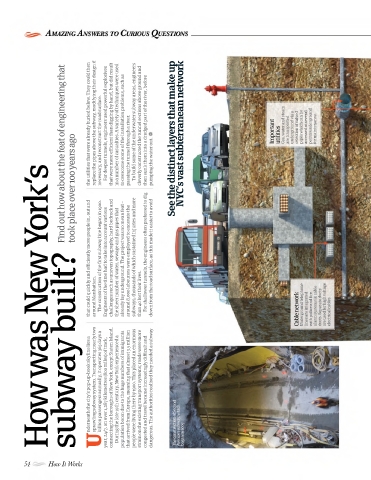
                                     necessary, and reconstruct the road surface.  replace the pipes above the subway, modifying their design if  For deeper tunnels, engineers used powerful explosives  that were more efficient than digging by hand, but did result     in a number of casualties. A variety of techniques were used  to overcome some of the installation problems, such as  passing the tunnel through a river.  To build some of the underwater subway areas, engineers  cleverly constructed the tunnel sections


                  s                                    pumping the water out.


                  ork’     took place over 100 years ago


                                 that could quickly and efficiently move people in, out and


                  How was New Y


                           subway built?
                                       The construction of the first subway line began in 1900.  Engineers of the time had to take into account various  challenges such as uneven topography, hard bedrock and  the sheer number of water, sewage and gas pipes that  already lay underground. The project was no mean feat –  around 8,000 labourers were employed to excavate the  subways, thousands of which sustained injuries and more  For shallower tunnels, the engineers often preferred to dig  down from the road surface, a

                                   around Manhattan.   than 40 lost their lives.                          Cable network  Underground telephone   lines are integrated    re  with police and fi alarm systems in cable  ducts. Separate ducts  are used for high voltage   electrical cables.


                                 nderneath the city’s pop-up-book skyline lies a  sprawling subway system. Transporting nearly two  Ubillion passengers annually, it operates 365 days a  year, 24/7, on over 1,287 kilometres (800 miles) of track,  connecting the boroughs of New York, except Staten Island. During the late 19th century, New York experienced a  population boom due to the huge numbers of immigrants  that arrived from Europe, meaning that almost 3.5 million  people were living there by 1900. This placed a


          54       How It Works                                 Avenue’s subway, which   began in 2007

