


Page 57 - How It Works - Book Of Amazing Answers To Curious Questions, Volume 05-15
P. 57
Technology


            How do sunglasses


            protect your eyes?


            The sight-saving secrets of a summer style staple

                  eaching for our sunglasses on a bright,   higher frequencies than the visible light our eyes   combat glare from reflective horizontal surfaces
                  sunny day is second nature; we all know   can perceive. They damage our eyes the same   like water, sand and snow.
            R that spending time in the Sun puts us at   way they damage our skin, except that even in   Light waves vibrate just like sound waves do.

            risk of eye damage and no one enjoys   the shade reflected rays pose a threat to our eyes.  There’s a mish-mash of horizontal and vertical
            a squinting-induced headache. Perhaps you take   Sunglass lenses are made from glass, plastic   components to these vibrations, but when light
            them for granted, but there’s more to your   or polycarbonate, with a special UV-absorbing   waves strike a uniform horizontal surface
            sunnies than shaded lenses.           coating. A good pair blocks more than 99 per   they are reflected with a strong, horizontal

              Aside from lending mere mortals an air of fi lm   cent of UV radiation from reaching your eyes.   polarisation. The glare we experience is the jam
            star mystique, sunglasses’ premier function is to   Tints and mirror coatings relieve you from   of light waves all vibrating in the exact same

            block the Sun’s harmful ultraviolet (UV) rays.   squinting by absorbing or refl ecting intense,   plane. Sunglasses fitted with a polarisation

            There are two types of UV rays: UVA (which   dazzling light in the visible part of the spectrum   film eliminate this kind of glare by only
            cause skin cancer and premature ageing) and   (the light we can actually see). The highest-grade   enabling vertically polarised light to
            UVB (responsible for sunburn). Both types have   sunglasses also incorporate a polarising fi lm to   pass through.
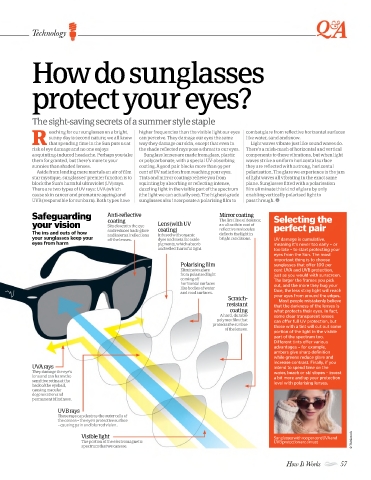
            Safeguarding               Anti-reflective                        Mirror coating     Selecting the
                                                                              The first line of defence;

            your vision                coating           Lens (with UV        an ultra-thin coat of
                                       Sits closest to the eye
                                       and reduces back-glare   coating)      refl ective molecules   perfect pair
            The ins and outs of how    and internal refl ections   Infused with organic   deflects the light in

            your sunglasses keep your   off the lenses.  dyes and metallic oxide   bright conditions.  UV damage is cumulative,
            eyes from harm                               pigments, which absorb                  meaning it’s never too early – or
                                                         and reflect harmful light.               too late – to start protecting your

                                                                                                 eyes from the Sun. The most
                                                                                                 important thing is to choose
                                                                Polarising film                  sunglasses that offer 100 per
                                                                Eliminates glare                 cent UVA and UVB protection,
                                                                from polarised light             just as you would with sunscreen.
                                                                coming off                       The larger the frames you pick
                                                                horizontal surfaces              out, and the more they hug your
                                                                like bodies of water             face, the less stray light will reach
                                                                and road surfaces.
                                                                                 Scratch-        your eyes from around the edges.
                                                                                                   Most people mistakenly believe
                                                                                 resistant       that the darkness of the lenses is
                                                                                  coating        what protects their eyes. In fact,
                                                                              A hard, durable    some clear transparent lenses
                                                                             polymer fi lm that   can offer full UV protection, but
                                                                            protects the surface   those with a tint will cut out some
                                                                                of the lenses.
                                                                                                 portion of the light in the visible
                                                                                                 part of the spectrum too.
                                                                                                 Different tints offer various
                                                                                                 advantages – for example,
                                                                                                 ambers give sharp defi nition
                                                                                                 while greens reduce glare and
                                                                                                 increase contrast. Finally, if you
            UVA rays                                                                             intend to spend time on the
            They damage the eye’s                                                                water, beach or ski slopes – invest
            lens and can harm the                                                                a bit more and up your protection
            sensitive retina at the                                                              level with polarising lenses.
            back of the eyeball,
            causing macular
            degeneration and
            permanent blindness.
                     UVB rays
                     These rays can destroy the outer cells of
                     the cornea – the eye’s protective surface
                     – causing pain and blurred vision.
                              Visible light                                                      Sunglasses with 100 per cent UVA and
                              The portion of the electromagnetic                                 UVB protection are a must   © Thinkstock
                              spectrum that we can see.


                                                                                                      How It Works        57

