


Page 59 - How It Works - Book Of Amazing Answers To Curious Questions, Volume 05-15
P. 59
Technology


                t’s somewhat hard to imagine our modern
                world without cash machines, yet they only
            Ibecame the norm during the 1970s. The fi rst
            machine that dispensed cash was invented by
            John Shepperd-Barron and was installed
            outside a branch of Barclays Bank in Enfi eld,
            Greater London.
              Today, they work to give us access to our money
            24 hours a day in a multitude of locations – and
            they are far more convenient than queuing in a
            bank. However, there are many challenges for
            them to overcome in order to provide the required
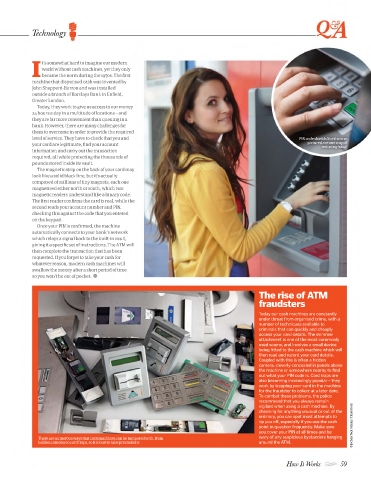
            level of service. They have to check that you and                                             PIN code shields like the one

            your card are legitimate, find your account                                                       pictured are one way of
                                                                                                                  reducing fraud
            information and carry out the transaction
            required, all while protecting the thousands of
            pounds stored inside its vault.
              The magnetic strip on the back of your card may
            look like a solid black line, but it’s actually
            composed of millions of tiny magnets, each one
            magnetised either north or south, which two
            magnetic readers understand like a binary code.

            The first reader confirms the card is real, while the

            second reads your account number and PIN,
            checking this against the code that you entered
            on the keypad.
              Once your PIN is confirmed, the machine

            automatically connects to your bank’s network
            which relays a signal back to the built-in vault,

            giving it a specific set of instructions. The ATM will
            then complete the transaction that has been
            requested. If you forget to take your cash for
            whatever reason, modern cash machines will
            swallow the money after a short period of time
            so you won’t be out of pocket.


                                                                                            The rise of ATM
                                                                                            fraudsters
                                                                                            Today our cash machines are constantly
                                                                                            under threat from organised crime, with a
                                                                                            number of techniques available to
                                                                                            criminals that can quickly and cheaply
                                                                                            access your card details. The skimmer
                                                                                            attachment is one of the most commonly
                                                                                            used scams, and involves a small device
                                                                                            being fitted to the cash machine which will

                                                                                            then read and record your card details.
                                                                                            Coupled with this is often a hidden
                                                                                            camera, cleverly concealed in panels above
                                                                                            the machine or somewhere nearby to fi nd
                                                                                            out what your PIN code is. Card traps are
                                                                                            also becoming increasingly popular – they
                                                                                            work by trapping your card in the machine
                                                                                            for the fraudster to collect at a later date.
                                                                                            To combat these problems, the police
                                                                                            recommend that you always remain
                                                                                            vigilant when using a cash machine. By
                                                                                            checking for anything unusual or out of the
                                                                                            ordinary, you can spot most attempts to
                                                                                            rip you off, especially if you use the cash
                                                                                            point in question frequently. Make sure   © Jochen Tack / Alamy; Thinkstock
                                                                                            you cover your PIN at all times and be
              There are numerous ways that cash machines can be tampered with, from         wary of any suspicious bystanders hanging
              hidden cameras to card traps, so it is best to take precautions               around the ATM.


                                                                                                      How It Works        59

