


Page 62 - How It Works - Book Of Amazing Answers To Curious Questions, Volume 05-15
P. 62
What are                                                                   Why do we

          black box                                                                  change the clocks

          flight recorders                                                           during the year?

          made from?                                                                    t was originally suggested in Britain by

                                                                                     I William Willett in 1907, to avoid wasting
                                                                                     the daylight during the summer when the

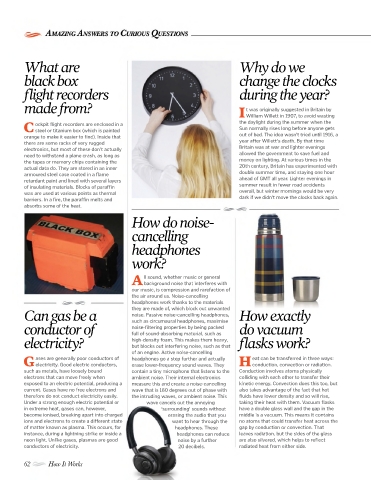
             ockpit flight recorders are enclosed in a
         C steel or titanium box (which is painted                                   Sun normally rises long before anyone gets
          orange to make it easier to find). Inside that                              out of bed. The idea wasn’t tried until 1916, a

          there are some racks of very rugged                                        year after Willett’s death. By that time
          electronics, but most of these don’t actually                              Britain was at war and lighter evenings
          need to withstand a plane crash, as long as                                allowed the government to save fuel and
          the tapes or memory chips containing the                                   money on lighting. At various times in the
          actual data do. They are stored in an inner                                20th century, Britain has experimented with
          armoured steel case coated in a fl ame                                      double summer time, and staying one hour
          retardant paint and lined with several layers                              ahead of GMT all year. Lighter evenings in
          of insulating materials. Blocks of paraffi n                                summer result in fewer road accidents
          wax are used at various points as thermal                                  overall, but winter mornings would be very
          barriers. In a fire, the paraffin melts and                                  dark if we didn’t move the clocks back again.


          absorbs some of the heat.
                                               How do noise-

                                               cancelling

                                               headphones

                                               work?


                                                    ll sound, whether music or general
                                               A background noise that interferes with
                                               our music, is compression and rarefaction of
                                               the air around us. Noise-cancelling
                                               headphones work thanks to the materials
                                               they are made of, which block out unwanted
         Can gas be a                          noise. Passive noise-cancelling headphones,   How exactly
                                               such as circumaural headphones, maximise
         conductor of                          noise-filtering properties by being packed   do vacuum

                                               full of sound-absorbing material, such as
         electricity?                          but blocks out interfering noise, such as that  flasks work?
                                               high-density foam. This makes them heavy,
                                               of an engine. Active noise-cancelling
              ases are generally poor conductors of   headphones go a step further and actually   eat can be transferred in three ways:
         G electricity. Good electric conductors,   erase lower-frequency sound waves. They  H conduction, convection or radiation.
         such as metals, have loosely bound    contain a tiny microphone that listens to the   Conduction involves atoms physically
         electrons that can move freely when   ambient noise. Their internal electronics   colliding with each other to transfer their
         exposed to an electric potential, producing a   measure this and create a noise-cancelling   kinetic energy. Convection does this too, but
         current. Gases have no free electrons and   wave that is 180 degrees out of phase with   also takes advantage of the fact that hot
         therefore do not conduct electricity easily.   the intruding waves, or ambient noise. This   fluids have lower density and so will rise,

         Under a strong enough electric potential or   wave cancels out the annoying   taking their heat with them. Vacuum fl asks
         in extreme heat, gases can, however,             ‘surrounding’ sounds without   have a double glass wall and the gap in the
         become ionised, breaking apart into charged        erasing the audio that you   middle is a vacuum. This means it contains
         ions and electrons to create a different state      want to hear through the   no atoms that could transfer heat across the
         of matter known as plasma. This occurs, for          headphones. These      gap by conduction or convection. That
         instance, during a lightning strike or inside a       headphones can reduce   leaves radiation, but the sides of the glass
         neon light. Unlike gases, plasmas are good            noise by a further    are also silvered, which helps to refl ect
         conductors of electricity.                             20 decibels.         radiated heat from either side.


          62       How It Works

