


Page 67 - How It Works - Book Of Amazing Answers To Curious Questions, Volume 05-15
P. 67
Science
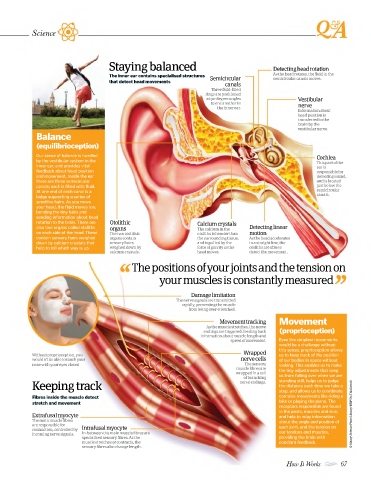
Staying balanced Detecting head rotation
As the head rotates, the fluid in the
The inner ear contains specialised structures Semicircular semicircular canals moves.
that detect head movements
canals
Three fl uid-fi lled
rings are positioned
at 90-degree angles Vestibular
to one another in nerve
the inner ear.
Information about
head position is
transferred to the
brain by the
vestibular nerve.
Balance
(equilibrioception)
Our sense of balance is handled Cochlea
by the vestibular system in the This part of the
inner ear, and provides vital ear is
feedback about head position responsible for
and movement. Inside the ear detecting sound,
there are three semicircular and is located
canals; each is filled with fl uid. just below the
At one end of each canal is a semicircular
bulge supporting a series of canals.
sensitive hairs. As you move
your head, the fluid moves too,
bending the tiny hairs and
sending information about head
rotation to the brain. There are Otolithic Calcium crystals
also two organs called otoliths organs The calcium in the Detecting linear
on each side of the head. These The two otolithic otoliths is heavier than motion
contain sensory hairs weighed organs contain the surrounding tissue, As the head accelerates
down by calcium crystals that sensory hairs and is pulled by the in a straight line, the
help to tell which way is up. weighed down by force of gravity as the otoliths are able to
calcium crystals. head moves. detect the movement.
The positions of your joints and the tension on
your muscles is constantly measured
Damage limitation
The nerve signals are transmitted
rapidly, preventing the muscle
from being over-stretched.
Movement tracking Movement
As the muscle stretches, the nerve
endings are triggered, feeding back (proprioception)
information about muscle length and
speed of movement. Even the simplest movements
would be a challenge without
this sense; proprioception allows
Wrapped
Without proprioception, you us to keep track of the position
wouldn’t be able to touch your nerve cells of our bodies in space without
nose with your eyes closed The sensory looking. This enables us to make
muscle fi bres are the tiny adjustments that keep
wrapped in a coil
of branching us from falling over when we are
standing still, helps us to judge
Keeping track nerve endings. the distance each time we take a
step, and allows us to coordinate
Fibres inside the muscle detect complex movements like riding a
bike or playing the piano. The
stretch and movement
receptors responsible are found
in the joints, muscles and skin,
Extrafusal myocyte and help to relay information © Alamy\ Science Photo Library/ BSIP SA; Thinkstock
The main muscle fi bres about the angle and position of
are responsible for each joint, and the tension on
contraction, controlled by Intrafusal myocyte our tendons and muscles,
incoming nerve signals. In-between the main muscle fi bres are
specialised sensory fibres. As the providing the brain with
muscle stretches or contracts, the constant feedback.
sensory fibres also change length.
How It Works 67

