


Page 70 - How It Works - Book Of Amazing Answers To Curious Questions, Volume 05-15
P. 70
How are we affected


         by neurotransmitters?


         Are our moods and emotions really just brain chemistry?

                  essages are passed from one nerve cell   are normally associated with more addictive   Schizophrenia Anxiety  Happiness
                  to the next by chemical messengers   behaviour types.
         M called neurotransmitters. Each has a    Noradrenaline is similar in structure to the
          slightly different effect and by looking at what   hormone adrenaline and is involved in the ‘fi ght
          happens when neurotransmitter levels change,   or flight’ response. In the brain, it keeps us alert

          we are discovering that different combinations   and focussed. In contrast, GABA reduces the
          play a role in a range of complex emotions.  activity of the nerves that it interacts with and is
           Acetylcholine excites the nerve cells that it   thought to reduce feelings of fear or anxiety.
          touches, triggering more electrical activity. It   Serotonin is sometimes known as the ‘happy   Depression  Love  Fight or fl ight
          plays a role in wakefulness, attention, learning   hormone’ and transmits signals involved in body
          and memory, and abnormally low levels are   temperature, sleep, mood and pain. People with
          found in the brains of people with dementia   depression have been found to have lower
          caused by Alzheimer’s disease.         serotonin levels than normal, though raising
           Dopamine is a chemical that also excites nerve   serotonin levels with antidepressant medications
          cells. It plays a vital role in the control of   does not always help.
          movement and posture, and low levels of   There are many more neurotransmitters in the
          dopamine underlie the muscle rigidity that exists   brain and other chemicals like hormones can

          in Parkinson’s disease. Dopamine is also used in   also influence the behaviour of nerve cells. It is   Dopamine  Serotonin  Oxytocin
                                                                                                Noradrenaline  Adrenaline
          the brain’s reward circuitry and is one of the   these interactions that are thought to underlie
          chemicals responsible for the good feelings that   the huge range of human emotions.
                                                                                            Different levels of neurotransmitters have been
                                                                                                 associated with different mental states
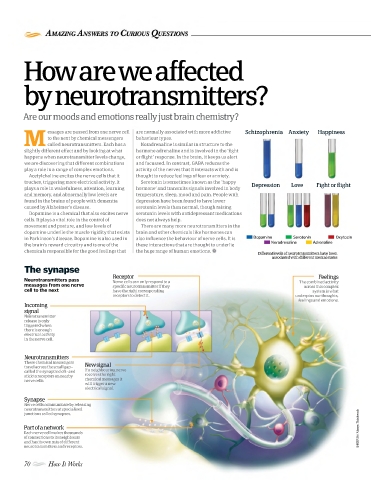
          The synapse
                                         Receptor                                                                Feelings
          Neurotransmitters pass         Nerve cells can only respond to a                                The combined activity
          messages from one nerve        specific neurotransmitter if they                                   across this complex

          cell to the next               have the right corresponding                                          system is what
                                         receptors to detect it.                                         underpins our thoughts,
                                                                                                          feelings and emotions.
          Incoming
          signal
          Neurotransmitter
          release is only
          triggered when
          there is enough
          electrical activity
          in the nerve cell.


          Neurotransmitters
          These chemical messengers   New signal
          travel across the small gap -
          called the synaptic cleft - and   If a neighbouring nerve
          stick to receptors on nearby   receives the right
          nerve cells.         chemical messages it
                               will trigger a new
                               electrical signal.
          Synapse
          Nerve cells communicate by releasing
          neurotransmitters at specialised
          junctions called synapses.

         Part of a network                                                                                                     © BSIP SA / Alamy; Thinkstock
         Each nerve cell makes thousands
         of connections to its neighbours
         and has its own mix of different
         neurotransmitters and receptors.

          70       How It Works

