


Page 94 - How It Works - Book Of Amazing Answers To Curious Questions, Volume 05-15
P. 94
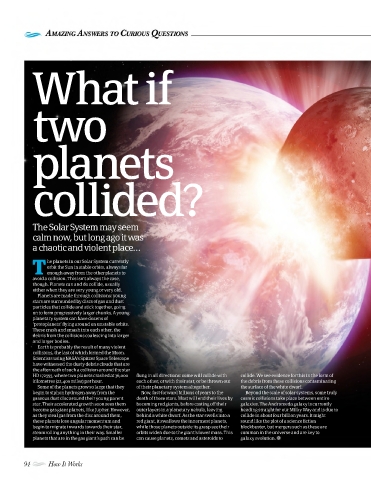
What if


             two


             planets


             collided?


             The Solar System may seem
             calm now, but long ago it was
             a chaotic and violent place…


                  he planets in our Solar System currently
                  orbit the Sun in stable orbits, always far
            Tenough away from the other planets to
             avoid a collision. This isn’t always the case,
             though. Planets can and do collide, usually
             either when they are very young or very old.
              Planets are made through collisions: young
             stars are surrounded by discs of gas and dust
             particles that collide and stick together, going
             on to form progressively larger chunks. A young
             planetary system can have dozens of

             ‘protoplanets’ flying around on unstable orbits.
             These crash and smash into each other, the
             debris from the collisions coalescing into larger
             and larger bodies.
              Earth is probably the result of many violent
             collisions, the last of which formed the Moon.
             Scientists using NASA’s Spitzer Space Telescope
             have witnessed the dusty debris clouds that are
             the aftermath of such a collision around the star

             HD 172555, where two planets crashed at 36,000   flung in all directions: some will collide with   collide. We see evidence for this in the form of
             kilometres (22,400 miles) per hour.  each other, or with their star, or be thrown out   the debris from these collisions contaminating
              Some of the planets grow so large that they   of their planetary system altogether.  the surface of the white dwarf.
             begin to siphon hydrogen away from the   Now, fast-forward billions of years to the   Beyond the scale of solar systems, some truly
             gaseous dust disc around their young parent   death of these stars. Most will end their lives by   cosmic collisions take place between entire
             star. Their accelerated growth soon sees them   becoming red giants, before casting off their   galaxies. The Andromeda galaxy is currently
             become gas giant planets, like Jupiter. However,   outer layers in a planetary nebula, leaving   heading straight for our Milky Way and is due to
             as they steal gas from the disc around them,   behind a white dwarf. As the star swells into a   collide in about four billion years. It might
             these planets lose angular momentum and   red giant, it swallows the innermost planets,   sound like the plot of a science fi ction
             begin to migrate inwards towards their star,   while those planets outside its grasp see their   blockbuster, but mergers such as these are
             steamrolling anything in their way. Smaller   orbits widen due to the giant’s lower mass. This   common in the universe and are key to
             planets that are in the gas giant’s path can be   can cause planets, comets and asteroids to   galaxy evolution.


          94       How It Works

