


Page 97 - How It Works - Book Of Amazing Answers To Curious Questions, Volume 05-15
P. 97
Space


                Menage à trois                       Collision
                The Triangulum galaxy,               In four billion years’   ‘Milkomeda’
                lurking about three million light    time the Andromeda
                years away, will also eventually     galaxy will merge
                merge with the new elliptical        with the Milky Way   Our Milky Way galaxy is stuck on a
                ‘Milkomeda’.                         and form a giant
                                                     elliptical galaxy.  collision course with another galaxy
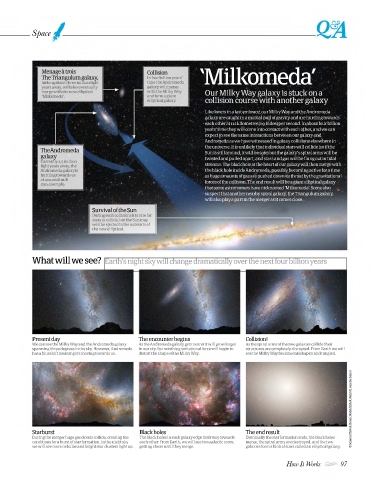
                                                                         Like lovers in a last embrace, our Milky Way and the Andromeda
                                                                         galaxy are caught in a mutual pull of gravity and are hurtling towards
                                                                         each other at 112 kilometres (69 miles) per second. In about four billion
                                                                         years’ time they will come into contact with each other, and we can
                                                                         expect to see the same interactions between our galaxy and
                                                                         Andromeda as we have witnessed in galaxy collisions elsewhere in
                                                                         the universe. It is unlikely that individual stars will collide (so if the
               The Andromeda                                             Sun is still around, it will be safe) but the galaxy’s spiral arms will be
               galaxy
               Currently 2.5 million                                     twisted and pulled apart, and stars and gas will be flung out in tidal
               light years away, the                                     streams. The black hole at the heart of our galaxy will then merge with
               Andromeda galaxy is                                       the black hole inside Andromeda, possibly becoming active for a time
               hurtling towards us                                       as huge amounts of gas are pushed down its throat by the gravitational
               at 400,000km/h
               (250,000mph).                                             forces of the collision. The end result will be a giant elliptical galaxy
                                                                         that some astronomers have nicknamed ‘Milkomeda’. Some also
                                                                         suspect that another nearby spiral galaxy, the Triangulum galaxy,
                                                                         will also play a part in the merger as it comes close.

                                 Survival of the Sun
                                 During such collisions it is rare for
                                 stars to collide, but the Sun may
                                 well be ejected to the outskirts of
                                 the new elliptical.


            What will we see?  Earth’s night sky will change dramatically over the next four billion years


            Present day                           The encounter begins                 Collision!
            We can see the Milky Way and the Andromeda galaxy   As the Andromeda galaxy gets nearer it will grow larger   As the spiral arms of the two galaxies collide their
            spanning three degrees in the sky. However, Andromeda   in our sky. Its invisible gravitational force will begin to   structures are completely disrupted. From Earth we will
            has a blueshift meaning it’s moving towards us.  distort the shape of the Milky Way.  see the Milky Way become misshapen and tangled.


                                                                                                                            © Science Photo Library; NASA/ESA/A. Feild/R. van der Marel


            Starburst                             Black holes                          The end result
            During the merger huge gas clouds collide, creating the   The black holes in each galaxy edge their way towards   Eventually the star formation ends, the black holes
            conditions for a burst of star formation. In the night sky   each other. From Earth, we will see two galactic cores,   merge, the spiral arms are destroyed, and the two
            we will see more nebulae and bright star clusters light up.  getting closer until they merge.  galaxies form a blob of stars called an elliptical galaxy.

                                                                                                      How It Works        97

