


Page 95 - How It Works - Book Of Amazing Answers To Curious Questions, Volume 05-15
P. 95
Space


                                                                                          P l a n et s c a n a  n d d  o
                                                                                          Planets can and do
                                                                     1. The big splash
                                  Scientists believe that our Moon was formed when a small protoplanet about   collide, usually either
                                   the size of Mars – which astronomers have called Theia – slammed into the
                                      young Earth. This collision took place less than 100 million years after
                                        the birth of the Solar System. The impact destroyed Theia and sent   when they are very
                                          some of Earth’s mantle flying into space, which formed a ring of
                                                                                      young or very old
                                               debris around our planet that coalesced into the Moon.
                                                                         2. Merger
                                                                When Theia struck Earth
                                                                   at high speed and an   The giant impact
                                                                    angle of around 45
                                                                 degrees, the protoplanet
                                                                 was pulverised, its iron   hypothesis
                                                                core sinking into the now
                                                                 molten Earth which had   The main evidence for the theory that the Moon was
                                                                been heated by the shock   formed by a giant impact comes from lunar rocks
                                                                 of the impact to create a   returned to Earth during the Apollo missions. These
                                                                   global ocean of lava.  rocks contain ratios of oxygen isotopes (atoms of a
                                                                                       given element that have a different number of
                                                                                       neutrons) that are almost exactly the same as those
                                                                                       found in Earth’s mantle. This suggests that the Moon is
                                                                                       made from material that came from our own planet’s
                                                                                       mantle. Material in those Moon rocks was also found
                                                                                       to have once been molten long ago, and an impact
                                                                                       would have provided the necessary energy to
                                                                                       efficiently melt rock.

                                                                                         Although the impact theory is now widely accepted,
                                                                                       a number of puzzling problems remain. For example,
                                                                                       some believe there should be more evidence of debris
                                                                   3. Goodbye mantle   material from Theia found in the Moon rocks. Also, the
                                                           While most of Theia was absorbed   rocks contain so-called volatile elements (materials
                                                           by the Earth – which grew in mass   that evaporate easily in relatively low temperatures)
                                                             in the process – some of Earth’s   such as water, which were embedded in the rocks
                                                           mantle and crust was ripped from   when they formed, yet the heat of an impact should
                                                           the planet and thrown into orbit in   have evaporated them. However, these puzzles remain
                                                               molten chunks. The impact   as details to be ironed out, rather than serious threats
                                                             changed the rotation of Earth,   to the impact theory.
                                                           speeding it up so that a day lasted
                                                                     only a few hours.


                       4.  Molten ring
              After the impact Earth actually
               had a ring, but unlike Saturn’s
               rings this one was glowing hot
              with molten rock. Some rained
               back down onto the Earth, but
              most stayed in orbit and cooled.


                                                                  5. Forming the Moon
                                                             Gradually, over a few thousand
                                                               years, the rubble in the ring
                                                                began to merge into larger
                                                              bodies which then combined                                    © Thinkstock; University of Arizona/Tom Story
                                                             to finally form the Moon, made
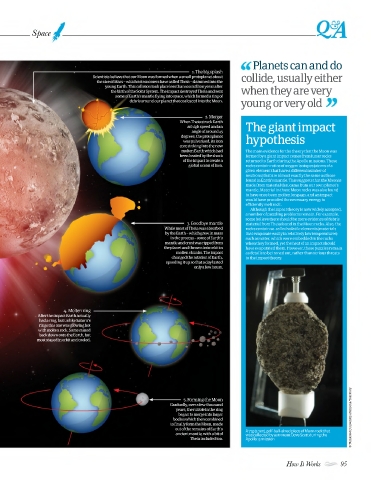
                                                               out of the remains of Earth’s   A 77g (2.7oz), golf-ball-sized piece of Moon rock that
                                                               ancient mantle, with a bit of   was collected by astronaut Dave Scott during the
                                                                    Theia included too.  Apollo 15 mission


                                                                                                      How It Works        95

