


Page 99 - How It Works - Book Of Amazing Answers To Curious Questions, Volume 05-15
P. 99
Space


            What is it like on                                                                             Beneath the clouds


            lonely                          planets?                                                    planets, even without a star, if
                                                                                                         Life could still exist on rogue
                                                                                                              the atmosphere and
                                                                                                          radioactive decay keep the
                                                                                                              world warm enough.


            Rogue planets are worlds without                 Thick atmosphere
                                                             If a rogue planet has a thick
            stars to orbit, but instead are lost             atmosphere, it could help to retain
                                                             warmth and preventing the world
            in interstellar space                            from freezing over, even in the dark
                                                             depths of space.

                  here are around 200 billion stars in our   Hypervelocity
                                                 The gravity of the black
                  galaxy, but astronomers have
                                                 hole is able to throw
            Testimated that there are 100,000 times   the planet away at a
            more rogue planets than there are stars. What   tremendous speed,
                                                 amounting to a
            are these lonely planets like?
                                                 few percent of the
              You might expect them to be cold and   speed of light.
            lifeless, but this is not necessarily
            the case. Some planets do not
            need a sun to stay warm. If
            their atmosphere is thick                                  Lonely among many       Heat from the core
            enough, coupled with                                       It’s thought that there are trillions   The core of a rogue planet can remain
            heating from the decay of                                  of rogue planets lost in the galaxy,   molten and radioactive elements in the
            radioactive elements in                                    and many more have been ejected   rock can decay and potentially produce
                                                                                               enough heat to maintain liquid oceans.
                                                                       from the galaxy altogether.
            the ground or from
            volcanoes, they could
            stay warm enough for
            liquid water and
            microbial life to exist.                                             Runaway worlds
            There is a good chance                                               Some rogue planets are in a real hurry,
            they might still be                                                  racing away from the Milky Way at 30
            hanging onto the dense                                               million miles per hour
            atmosphere of hydrogen
            and helium they were born
            with, because they do not                  Black hole
            have the stellar wind of a                 When a star with a planet
            nearby star to blow the                    gets too close to the
                                                       supermassive black hole in
            atmosphere away.                           the Milky Way, it fl ings the
              So what causes these worlds to become    planet away from its star.
            runaways? There are at least three ways. The
            first is that they could be born alone – some of

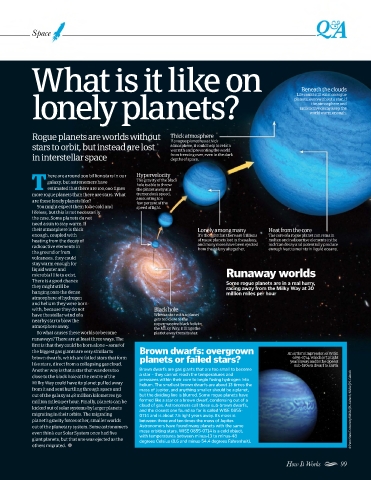
            the biggest gas giants are very similar to   Brown dwarfs: overgrown                      An artist’s impression of WISE
            brown dwarfs, which are failed stars that form   planets or failed stars?                   0855-0714, which is 7.2 light
            like stars, direct from a collapsing gas cloud.                                            years away and is the closest
                                                                                                        sub-brown dwarf to Earth
            Another way is that a star that wanders too   Brown dwarfs are gas giants that are too small to become
                                                  a star – they cannot reach the temperatures and
            close to the black hole at the centre of the
                                                  pressures within their core to begin fusing hydrogen into
            Milky Way could have its planet pulled away   helium. The smallest brown dwarfs are about 13 times the
            from it and sent hurtling through space and   mass of Jupiter, and anything smaller should be a planet,
            out of the galaxy at 48 million kilometres (30   but the dividing line is blurred. Some rogue planets have
            million miles) per hour. Finally, planets can be   formed like a star or a brown dwarf, condensing out of a
                                                  cloud of gas. Astronomers call these sub-brown dwarfs,
            kicked out of solar systems by larger planets
                                                  and the closest one found so far is called WISE 0855-                     © Penn State University/NASA/JPL-Caltech; NASA/JPL-Caltech
            migrating in their orbits. The migrating   0714 and is about 7.5 light years away. Its mass is
            planet’s gravity forces other, smaller worlds   between three and ten times the mass of Jupiter.
            out of the planetary system. Some astronomers   Astronomers have found many planets with the same
                                                  mass orbiting stars. WISE 0855-0714 is a cold object,
            even think our Solar System once had fi ve
                                                  with temperatures between minus-13 to minus-48
            giant planets, but that one was ejected as the   degrees Celsius (8.6 and minus-54.4 degrees Fahrenheit).
            others migrated.
                                                                                                                         99
                                                                                                      How It Works        99
                                                                                                      How It Works

