


Page 133 - (DK Eyewitness) Travel Guide - Prague
P. 133
LIT TLE QU AR TER 131
This wax effigy has a record of
miracle cures and is one of the
most revered images in the
Catholic world. It was brought
from Spain and presented
to the Carmelites in 1628 by
Polyxena of Lobkowicz. The
Museum of the Prague Infant
Jesus, adjacent to the church,
traces its history. Among the
items on display are the various
robes that adorn the statue. The
colours of the robes change with
the liturgical calendar: white at
Christmas and Easter, purple for
Lent, red for Holy Week and
green the rest of the year.
0 Maltese Square
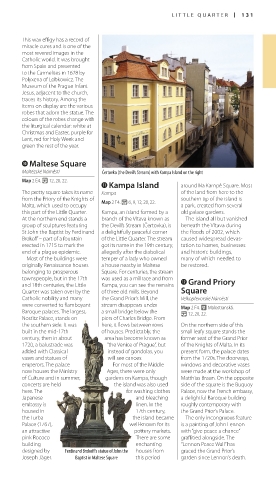
Maltézské Náměstí Čertovka (the Devil’s Stream) with Kampa Island on the right
Map 2 E4. v 12, 20, 22.
q Kampa Island around Na Kampě Square. Most
The pretty square takes its name Kampa of the land from here to the
from the Priory of the Knights of Map 2 F4. v 6, 9, 12, 20, 22. southern tip of the island is
Malta, which used to occupy a park, created from several
this part of the Little Quarter. Kampa, an island formed by a old palace gardens.
At the northern end stands a branch of the Vltava known as The island all but vanished
group of sculptures featuring the Devil’s Stream (Čertovka), is beneath the Vltava during
St John the Baptist by Ferdinand a delightfully peaceful corner the floods of 2002, which
Brokoff – part of a fountain of the Little Quarter. The stream caused widespread devas-
erected in 1715 to mark the got its name in the 19th century, tation to homes, businesses
end of a plague epidemic. allegedly after the diabolical and historic buildings,
Most of the buildings were temper of a lady who owned many of which needed to
originally Renaissance houses a house nearby in Maltese be restored.
belonging to prosperous Square. For centuries, the stream
townspeople, but in the 17th was used as a mill race and from w Grand Priory
and 18th centuries, the Little Kampa, you can see the remains
Quarter was taken over by the of three old mills. Beyond Square
Catholic nobility and many the Grand Prior’s Mill, the Velkopřevorské Náměstí
were converted to flamboyant stream disappears under Map 2 F4. X Malostranská.
Baroque palaces. The largest, a small bridge below the v 12, 20, 22.
Nostitz Palace, stands on piers of Charles Bridge. From
the southern side. It was here, it flows between rows On the northern side of this
built in the mid-17th of houses. Predictably, the small leafy square stands the
century, then in about area has become known as former seat of the Grand Prior
1720, a balustrade was “the Venice of Prague”, but of the Knights of Malta. In its
added with Classical instead of gondolas, you present form, the palace dates
vases and statues of will see canoes. from the 1720s. The doorways,
emperors. The palace For most of the Middle windows and decorative vases
now houses the Ministry Ages, there were only were made at the workshop of
of Culture and in summer, gardens on Kampa, though Matthias Braun. On the opposite
concerts are held the island was also used side of the square is the Buquoy
here. The for washing clothes Palace, now the French embassy,
Japanese and bleaching a delightful Baroque building
embassy is linen. In the roughly contemporary with
housed in 17th century, the Grand Prior’s Palace.
the Turba the island became The only incongruous feature
Palace (1767), well-known for its is a painting of John Lennon
an attractive pottery markets. with “give peace a chance”
pink Rococo There are some graffitied alongside. The
building enchanting “Lennon Peace Wall” has
designed by Ferdinand Brokoff’s statue of John the houses from graced the Grand Prior’s
Joseph Jäger. Baptist in Maltese Square this period garden since Lennon’s death.
130-131_EW_Prague.indd 131 20/03/17 11:29 am

