


Page 137 - (DK Eyewitness) Travel Guide - Prague
P. 137
LIT TLE QU AR TER 135
u Kafka Museum of Barefooted Carmelites.
Kafkovo Muzeum Two chapels erected by the
Order have survived among
Cihelná 2b. Map 2 F3. X Malostranská.
Tel 257 535 373. v 12, 18, 20, 22. the park’s lawns and fruit trees.
Open 10am–6pm daily. & = One is the Chapel of Elijah, who,
∑ kafkamuseum.cz because of his Old Testament
associations with Mount Carmel,
This museum houses the long- is regarded as the founder of
term exhibition “The City of the Order. His chapel takes
Franz Kafka and Prague”. The the form of a stalagmite and
author Franz Kafka was born stalactite cave. The other chapel,
in Prague in 1883. He wrote dedicated to St Theresa, was
visionary works that are consid- built in the 18th century as an
ered some of the most important expression of gratitude for the
of the 20th century, including convent’s preservation during
The Trial, The Metamorphosis the Prussian siege of Prague
and The Castle. in 1757.
The exhibition has two
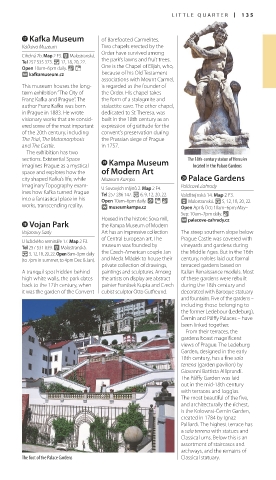
sections. Existential Space o Kampa Museum The 18th-century statue of Hercules
imagines Prague as a mystical located in the Palace Gardens
space and explores how the of Modern Art
city shaped Kafka’s life, while Muzeum Kampa p Palace Gardens
Imaginary Topography exam- U Sovových mlýnů 2. Map 2 F4. Palácové Zahrady
ines how Kafka turned Prague Tel 257 286 147. v 6, 9, 12, 20, 22. Valdštejnská 14. Map 2 F3.
into a fantastical place in his Open 10am–6pm daily. 0 = & X Malostranská. v 5, 12, 18, 20, 22.
works, transcending reality. ∑ museumkampa.cz Open Apr & Oct: 10am–6pm; May–
Sep: 10am–7pm daily. &
Housed in the historic Sova mill, ∑ palacove-zahrady.cz
i Vojan Park the Kampa Museum of Modern
Vojanovy Sady Art has an impressive collection The steep southern slope below
of Central European art. The Prague Castle was covered with
U lužického semináře 17. Map 2 F3.
Tel 257 531 839. X Malostranská. museum was founded by vineyards and gardens during
v 5, 12, 18, 20, 22. Open 8am–5pm daily the Czech-American couple Jan the Middle Ages. But in the 16th
(to 7pm in summer, to 4pm Dec & Jan). and Meda Mládek to house their century, nobles laid out formal
private collection of drawings, terraced gardens based on
A tranquil spot hidden behind paintings and sculptures. Among Italian Renaissance models. Most
high white walls, the park dates the artists on display are abstract of these gardens were rebuilt
back to the 17th century, when painter Frantisek Kupka and Czech during the 18th century and
it was the garden of the Convent cubist sculptor Otto Gutfreund. decorated with Baroque statuary
and fountains. Five of the gardens –
including those belonging to
the former Ledebour (Ledeburg),
Černín and Pálffy Palaces – have
been linked together.
From their terraces, the
gardens boast magnificent
views of Prague. The Ledeburg
Garden, designed in the early
18th century, has a fine sala
terrena (garden pavilion) by
Giovanni Battista Alliprandi.
The Pálffy Garden was laid
out in the mid-18th century
with terraces and loggias.
The most beautiful of the five,
and architecturally the richest,
is the Kolowrat-Černín Garden,
created in 1784 by Ignaz
Palliardi. The highest terrace has
a sala terrena with statues and
Classical urns. Below this is an
assortment of staircases and
archways, and the remains of
The foot of the Palace Gardens Classical statuary.
134-135_EW_Prague.indd 135 20/03/17 11:29 am

