


Page 146 - (DK Eyewitness) Travel Guide - Prague
P. 146
144 PR A GUE AREA B Y AREA
Street-by-Street: Wenceslas Square
Hotels and restaurants occupy many of the buildings around Wenceslas Koruna Palace (1914) is
Square, though it remains an important commercial centre – the an ornate block of shops
square began life as a medieval horse market. As you walk along, look and offices. Its corner
up at the buildings, most of which date from the turn of last century, turret is topped with
a crown (koruna).
when the square was redeveloped. There are fine examples
of the decorative styles used by Czech architects of the To Powder
period. Many blocks have covered arcades leading Gate
to shops, clubs, theatres and cinemas.
N A P Ř Í K O P Ě
U Pinkasů (see p203) became
one of Prague’s most popular
beer halls when it started
serving Pilsner Urquell Můstek
(see pp196–7) in 1843.
2 Church of Our Lady
of the Snows
The towering Gothic build- JINDŘIŠSKÁ
ing is only part of a vast
church planned during the Můstek
14th century.
Můstek
V O D I Č K O V A Můstek
3 Franciscan Garden
An old monastery garden has Á
been laid out as a small park K V Á C L A V S K E N Á M Ě S T Í
with this fountain, rose beds, N S
trellises and a children’s P Á
playground. Ě
Jungmann Square is named after Josef Š T
Jungmann (1773–1847), an influential scholar
of language and lexicographer, and there is a
statue of him in the middle. The Adria Palace Lucerna
(1925) used to be the Laterna Magika Theatre Palace
(see p218), which was where Václav Havel’s Civic V E S M E Č K Á C H
Forum worked in the early days of the 1989
Velvet Revolution.
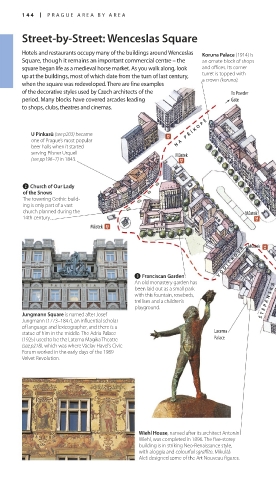
Wiehl House, named after its architect Antonín
Wiehl, was completed in 1896. The five-storey
building is in striking Neo-Renaissance style,
with aloggia and colourful sgraffito. Mikuláš
Aleš designed some of the Art Nouveau figures.
144-145_EW_Prague.indd 144 20/03/17 11:29 am
Eyewitness Travel LAYERS PRINTED:
Starsight template “UK” LAYER
(Source v1.9)
Date 28th August 2012
Size 125mm x 217mm

