


Page 165 - (DK Eyewitness) Travel Guide - Italian Riviera
P. 165
THE RIVIER A DI PONENTE 163
Ludovico Brea
Of the many foreign artists working in Liguria, and in particular on the Riviera di Ponente,
between the mid-15th century and the mid-16th century, Ludovico Brea (c.1450–c.1523)
is the best documented. Born in Nice, Brea became a painter in his native city and was
probably influenced by the artistic trends emanating from Avignon. Cultural exchange,
encouraged by trade between Liguria and the South of France – a depot for goods from
northern Europe – was lively at that time, and it was not unusual for Flemish paintings, or
for the artists themselves, to find themselves in the Ligurian area. Thus, Ludovico Brea was
able to learn from, and be influenced by, works from different schools of painting, and to
absorb a variety of cultural elements. Of northern European styles, he was particularly
interested in Flemish art, but was also fascinated by the miniatures found in medieval
manuscripts. Brea was extremely adept at understanding the taste of his Ligurian
patrons, a skill that enabled him to work in Italy for many years. After producing some
early work in his native city, Brea transferred to Liguria. Traces of his various moves and of
his life in general at that time are scant, and generalizations about his artistic influences
are usually made by stydying his later work. While in Liguria, visitors may also come across
the work of Ludovico’s brother, Antonio, and his son, Francisco.
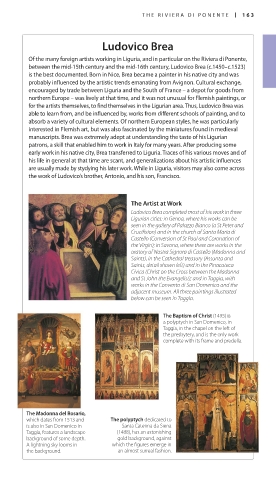
The Artist at Work
Ludovico Brea completed most of his work in three
Ligurian cities: in Genoa, where his works can be
seen in the gallery of Palazzo Bianco (a St Peter and
Crucifixion) and in the church of Santa Maria di
Castello (Conversion of St Paul and Coronation of
the Virgin); in Savona, where there are works in the
oratory of Nostra Signora di Castello (Madonna and
Saints), in the Cathedral treasury (Assunta and
Saints, detail shown left) and in the Pinacoteca
Civica (Christ on the Cross between the Madonna
and St John the Evangelist); and in Taggia, with
works in the Convento di San Domenico and the
adjacent museum. All three paintings illustrated
below can be seen in Taggia.
The Baptism of Christ (1495) is
a polyptych in San Domenico, in
Taggia, in the chapel on the left of
the presbytery, and is the only work
complete with its frame and predella.
The Madonna del Rosario,
which dates from 1513 and The polyptych dedicated to
is also in San Domenico in Santa Caterina da Siena
Taggia, features a landscape (1488), has an astonishing
background of some depth. gold background, against
A lightning sky looms in which the figures emerge in
the background. an almost surreal fashion.
162-163_EW_Italian_Riviera.indd 163 09/09/16 10:48 am

