


Page 37 - (DK Eyewitness) Travel Guide - New Orleans
P. 37
NE W ORLEANS A T A GLANCE 35
then another from 1865 to
the 1890s. By 1870, there were
more than 15,000 living in New
Orleans itself. For a time, they
were the largest immigrant
group in Louisiana.
The Cajuns
When the British gained
control of French Canada,
they insisted that the Acadians
swear an oath to the British
crown. When they refused,
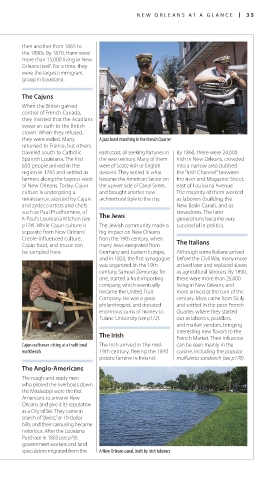
they were exiled. Many A jazz band marching in the French Quarter
returned to France, but others
traveled south to Catholic east coast, all seeking fortunes in By 1860, there were 24,000
Spanish Louisiana. The first the new territory. Many of them Irish in New Orleans, crowded
650 people arrived in the were of Scots-Irish or English into a narrow area dubbed
region in 1765 and settled as descent. They settled in what the “Irish Channel” between
farmers along the bayous west became the American Sector on the river and Magazine Street,
of New Orleans. Today, Cajun the upriver side of Canal Street, east of Louisiana Avenue.
culture is undergoing a and brought another new The majority of them worked
renaissance, assisted by Cajun architectural style to the city. as laborers (building the
and zydeco artists and chefs New Basin Canal), and as
such as Paul Prudhomme, of stevedores. The later
K-Paul’s Louisiana Kitchen (see The Jews generations became very
p174). While Cajun culture is The Jewish community made a successful in politics.
separate from New Orleans’ big impact on New Orleans
Creole-influenced culture, from the 19th century, when
Cajun food, and music can many Jews emigrated from The Italians
be sampled here. Germany and Eastern Europe, Although some Italians arrived
and in 1828, the first synagogue before the Civil War, many more
was organized. In the 19th arrived later and replaced slaves
century, Samuel Zemurray, for as agricultural laborers. By 1890,
one, started a fruit-importing there were more than 25,000
company, which eventually living in New Orleans, and
became the United Fruit more arrived at the turn of the
Company. He was a great century. Most came from Sicily
philanthropist, and donated and settled in the poor French
enormous sums of money to Quarter, where they started
Tulane University (see p112). out as laborers, peddlers,
and market vendors, bringing
interesting new flavors to the
The Irish
French Market. Their influence
Cajun craftsman sitting at a traditional The Irish arrived in the mid- can be seen mainly in the
workbench 19th century, fleeing the 1840 cuisine, including the popular
potato famine in Ireland. muffuletta sandwich (see p170).
The Anglo-Americans
The rough-and-ready men
who piloted the riverboats down
the Mississippi were the first
Americans to arrive in New
Orleans and give it its reputation
as a City of Sin. They came in
search of “dixies,” or 10-dollar
bills, and their carousing became
notorious. After the Louisiana
Purchase in 1803 (see p19),
government workers and land
speculators migrated from the A New Orleans canal, built by Irish laborers
034-035_EW_New_Orl.indd 35 05/08/16 3:48 pm

