


Page 14 - History of War - Issue 25-16
P. 14
Frontline

                                                                                         ANKS


                                                            From the tracked triumphs that rumbled
                                                         across battlei elds in the wake of WWII, to
                                                                            the sophisticated modern-day

                                                                            armoured monsters, the MBT
                                                                              dominated most of the 20th
                                                                                 century’s major war zones


                                                       COMPOSITEARMOUR

                                    Above: The Centurion saw   PROVIDING GREATER PROTECTION AND LIGHTER WEIGHT
                                  combat in the front lines into   First introduced: 1955 Country: United States
                                             the 1980s
                                                       Composite armour revolutionised the development of armoured vehicles, particularly
          CENTURION TANK                               the main battle tank. Conceived and applied for the irst time with the US Army’s T95
                                                       experimental tank series, the
          THE FIRST MAIN BATTLE TANK, OR UNIVERSAL TANK  initial composite armour was
          First introduced: 1945 Country: Great Britain  noted for its “siliceous core”
          In response to the combat experience of British   and included fused silica
          armoured forces during World War II, particularly against   glass between rolled steel
          the heavy German Tiger tank, specii cations were issued   plates for better protection
          for a new tank incorporating speed, i repower, armour   and lighter weight.
          protection, and a modicum of weight. The Centurion was
          produced in no fewer than a dozen variants, or marks.
                                                       Right: The experimental T95
                                                       medium tank was the i rst to utilise
                                                       composite armour

                                                                                            “WIDELY ACCLAIMED AS

                                                                                      BRITAIN’S MOST SUCCESSFUL
                                                                                         TANK WEAPON AND ONE OF

                                                                                                THE WORLD’S BEST”


                                                                              L7105MML/52GUN

                                                                              HEAVY WEAPON, WITH A LIGHTER PLATFORM
                                                                              First introduced: 1956 Country: Great Britain
                                                                              The main battle tank gained signiicant traction with the
                                                                              realisation that it was capable of carrying increasingly
                                                                              powerful main weapons. Widely acclaimed as Britain’s
                                                                              most successful tank weapon and one of the world’s
                                                                              best, the Royal Ordnance L7 105mm L/52 riled gun was
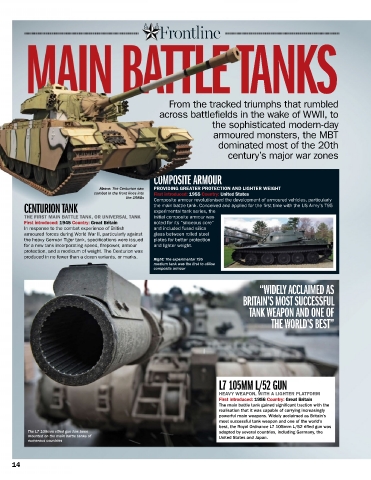
           The L7 105mm ril ed gun has been                                   adopted by several countries, including Germany, the
           mounted on the main battle tanks of                                United States and Japan.
           numerous countries


     14

