


Page 27 - History of War - Issue 25-16
P. 27
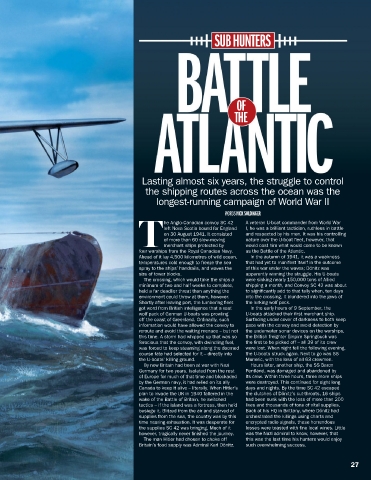
SUB HUNTERS


                                                                                    OF
                                                                                    THE


                                                   Lasting almost six years, the struggle to control
                                                    the shipping routes across the ocean was the
                                                        longest-running campaign of World War II

                                                                                WORDSNICKSOLDINGER
                                                           he Anglo-Canadian convoy SC 42  A veteran U-boat commander from World War
                                                           left Nova Scotia bound for England  I, he was a brilliant tactician, ruthless in battle
                                                           on 30 August 1941. It consisted  and respected by his men. It was his controlling
                                                           of more than 60 slow-moving   nature over the U-boat leet, however, that
                                                  T merchant ships protected by        would cost him what would come to be known
                                                  four warships from the Royal Canadian Navy.  as the Battle of the Atlantic.
                                                  Ahead of it lay 4,500 kilometres of wild ocean,  In the autumn of 1941, it was a weakness
                                                  temperatures cold enough to freeze the sea  that had yet to manifest itself in the outcome
                                                  spray to the ships’ handrails, and waves the  of this war under the waves; Dönitz was
                                                  size of tower blocks.                apparently winning the struggle. His U-boats
                                                    The crossing, which would take the ships a  were sinking nearly 150,000 tons of Allied
                                                  minimum of two and half weeks to complete,  shipping a month, and Convoy SC 42 was about
                                                  held a far deadlier threat than anything the  to signiicantly add to that tally when, ten days
                                                  environment could throw at them, however.  into the crossing, it blundered into the jaws of
                                                  Shortly after leaving port, the lumbering l eet  the lurking wolf pack.
                                                  got word from British intelligence that a vast  In the early hours of 9 September, the
                                                  wolf pack of German U-boats was prowling  U-boats attacked their irst merchant ship.
                                                  off the coast of Greenland. Ordinarily, such  Surfacing under cover of darkness to both keep
                                                  information would have allowed the convoy to  pace with the convoy and avoid detection by
                                                  reroute and avoid the waiting menace – but not  the underwater sonar devices on the warships,
                                                  this time. A storm had whipped up that was so  the British freighter Empire Springbuck was
                                                  ferocious that the convoy, with dwindling fuel,  the irst to be picked off – all 39 of its crew
                                                  was forced to keep steaming along the doomed  were lost. When night fell the following evening,
                                                  course fate had selected for it – directly into  the U-boats struck again. Next to go was SS
                                                  the U-boats’ killing ground.         Muneric, with the loss of all 63 crewmen.
                                                    By now Britain had been at war with Nazi  Hours later, another ship, the SS Baron
                                                  Germany for two years. Isolated from the rest  Pentland, was damaged and abandoned by
                                                  of Europe for much of that time and blockaded  its crew. Within three hours, three more ships
                                                  by the German navy, it had relied on its ally  were destroyed. This continued for eight long
                                                  Canada to keep it alive – literally. When Hitler’s  days and nights. By the time SC 42 escaped
                                                  plan to invade the UK in 1940 faltered in the  the clutches of Dönitz’s cut-throats, 16 ships
                                                  wake of the Battle of Britain, he switched   had been sunk with the loss of more than 200
                                                  tactics – if the island was a fortress, then he’d  lives and thousands of tons of vital supplies.
                                                  besiege it. Blitzed from the air and starved of  Back at his HQ in Brittany, where Dönitz had
                                                  supplies from the sea, the country was by this  orchestrated the killings using charts and
                                                  time nearing exhaustion. It was desperate for  encrypted radio signals, these horrendous
                                                  the supplies SC 42 was bringing. Much of it  losses were toasted with ine local wines. Little
                                                  however, tragically never i nished the journey.  was the Nazi admiral to know, however, that
                                                    The man Hitler had chosen to choke off  this was the last time his hunters would enjoy
                                                  Britain’s food supply was Admiral Karl Dönitz.  such overwhelming success.


                                                                                                                            27

