


Page 32 - History of War - Issue 25-16
P. 32
SUB HUNTERS


                                         DEFENDINGBRITAIN’SCOAST


                     THE SYSTEM IMPLEMENTED TO KEEP THE U-BOATS OF BRITISH PORTS OUT WAS INGENIOUS AND COMPLEX
          Britain’s ports played a pivotal role in protecting
          the Atlantic convoys. After all, these were where                           Large wooden or metal l oats, like these barrel l oats,
                                                                                          helped keep the huge suspended nets in place
          the ships that confronted the U-boats sailed to
          and from, so it was little wonder that this might
          make them highly valuable targets for U-boat
          attacks themselves.
           The British had actually been aware of this
          possibility long before hostilities broke out.
          Indeed some of the technology the British
          would use – such as steel anti-submarine
          netting known as indicator nets draped across
          harbour entrances – had proved their worth
          in World War I when a number of German
          U-boats became ensnared in them and were
          subsequently sunk with depth charges. In fact,
          preparations were being made for a revival of
          the defence around Britain’s more important
          ports as early as 1938.
           Work readying the Clyde Estuary for war,
          for example, was started in the wake of the
          notorious Munich Conference, which British
          PM Chamberlain had returned from promising
          the British people that war with Hitler had
          been averted. It hadn’t, of course, and when
          hostilities broke out less than a year later,
          a huge steel indicator net had already been
          manufactured that was swiftly hauled into
          position by eight boom ships to seal off the
          Clyde from U-boats.

          “PREPARATIONS WERE BEING
          MADE FOR A REVIVAL OF THE

          DEFENCE AROUND BRITAIN’S
          MORE IMPORTANT PORTS AS

          EARLY AS 1938”


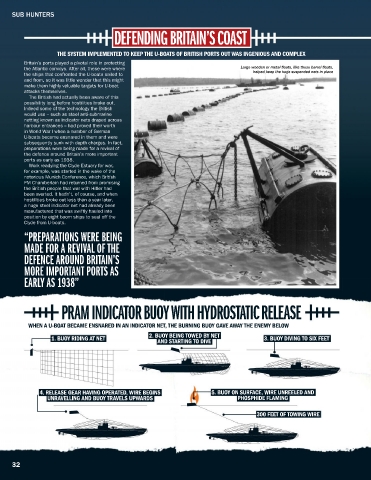
                       PRAMINDICATORBUOYWITHHYDROSTATICRELEASE


           WHEN A U-BOAT BECAME ENSNARED IN AN INDICATOR NET, THE BURNING BUOY GAVE AWAY THE ENEMY BELOW
                                                     2. BUOY BEING TOWED BY NET
                   1. BUOY RIDING AT NET                                                      3. BUOY DIVING TO SIX FEET
                                                        AND STARTING TO DIVE


               4. RELEASE GEAR HAVING OPERATED, WIRE BEGINS                5. BUOY ON SURFACE, WIRE UNREELED AND
                  UNRAVELLING AND BUOY TRAVELS UPWARDS                              PHOSPHIDE FLAMING

                                                                                           300 FEET OF TOWING  WIRE


     32

