


Page 29 - History of War - Issue 25-16
P. 29
BATTLE OF THE ATLANTIC


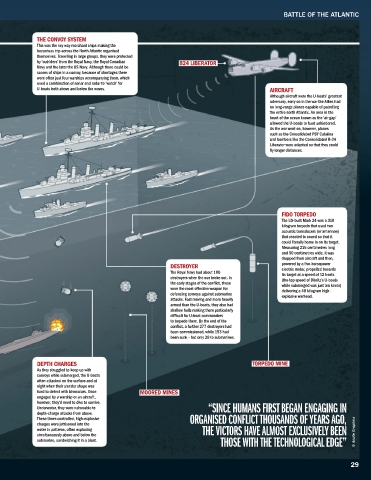
              THE CONVOY SYSTEM
              This was the key way merchant ships making the
              hazardous trip across the North Atlantic organised
              themselves. Travelling in large groups, they were protected
              by ‘outriders’ from the Royal Navy, the Royal Canadian   B24 LIBERATOR
              Navy and the later the US Navy. Although there could be
              scores of ships in a convoy, because of shortages there
              were often just four warships accompanying them, which
              used a combination of sonar and radar to ‘watch’ for
              U-boats both above and below the waves.                                           AIRCRAFT
                                                                                                Although aircraft were the U-boats’ greatest
                                                                                                adversary, early on in the war the Allies had
                                                                                                no long-range planes capable of patrolling
                                                                                                the entire north Atlantic. An area in the
                                                                                                heart of the ocean known as the ‘air gap’
                                                                                                allowed the U-boats to hunt unhindered.
                                                                                                As the war went on, however, planes
                                                                                                such as the Consolidated PBY Catalina
                                                                                                and bombers like the Consolidated B-24
                                                                                                Liberator were adapted so that they could
                                                                                                l y longer distances.


                                                                                                    FIDO TORPEDO
                                                                                                    The US-built Mark 24 was a 310
                                                                                                    kilogram torpedo that used two
                                                                                                    acoustic transducers (or antennae)
                                                                                                    that reacted to sound so that it
                                                                                                    could literally home in on its target.
                                                                                                    Measuring 215 centimetres long
                                                                                                    and 50 centimetres wide, it was
                                                                                                    dropped from aircraft and then,
                                                             DESTROYER                              powered by a ive-horsepower
                                                             The Royal Navy had about 180           electric motor, propelled towards
                                                                                                    its target at a speed of 12 knots
                                                             destroyers when the war broke out. In  (the top speed of Dönitz’s U-boats
                                                             the  early stages of the conlict, these  while submerged was just ten knots)
                                                             were the most effective weapon for     delivering a 40 kilogram high-
                                                             defending convoys against submarine    explosive warhead.
                                                             attacks. Fast moving and more heavily
                                                             armed  than the U-boats, they also had
                                                             shallow hulls making them particularly
                                                             difi cult for U-boat commanders
                                                             to torpedo them. By the end of the
                                                             conl ict, a further 277 destroyers had
                                                             been commissioned, while 153 had
                                                             been sunk – but only 28 to submarines.


              DEPTH CHARGES                                                               TORPEDO MINE
              As they struggled to keep up with
              convoys while submerged, the U-boats
              often attacked on the surface and at
              night when their slender shape was
              hard to detect with binoculars. Once   MOORED MINES
              engaged by a warship or an aircraft,
              however, they’d need to dive to survive.
              Underwater, they were vulnerable to                         “SINCE HUMANS FIRST BEGAN ENGAGING IN
              depth-charge attacks from above.
              These timer-controlled, high-explosive                ORGANISED CONFLICT THOUSANDS OF YEARS AGO,
              charges were jettisoned into the
              water in patterns, often exploding                        THE VICTORS HAVE ALMOST EXCLUSIVELY BEEN              © Acute Graphics
              simultaneously above and below the
                                                                               THOSE WITH THE TECHNOLOGICAL EDGE”
              submarine, sandwiching it in a blast.


                                                                                                                            29

