


Page 28 - History of War - Issue 25-16
P. 28
SUB HUNTERS


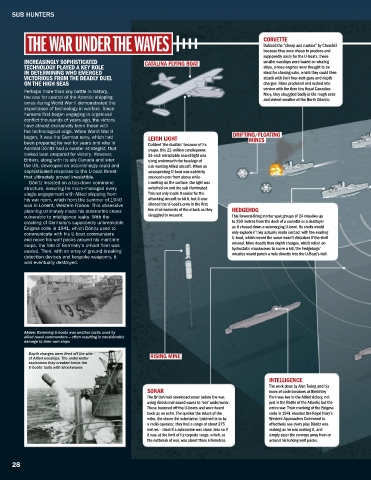
           THE WAR UNDER THE WAVES                                                            CORVETTE
                                                                                              Dubbed the “cheap and nasties” by Churchill
                                                                                              because they were cheap to produce and
                                                                                              supposedly nasty for the U-boats, these
          INCREASINGLY SOPHISTICATED                CATALINA FLYING BOAT                      smaller warships were based on whaling
          TECHNOLOGY PLAYED A KEY ROLE                                                        ships, whose engines were thought to be
          IN DETERMINING WHO EMERGED                                                          ideal for chasing subs, which they could then
          VICTORIOUS FROM THE DEADLY DUEL                                                     attack with their four-inch guns and depth
          ON THE HIGH SEAS                                                                    charges. Mass produced and rushed into
                                                                                              service with the then tiny Royal Canadian
          Perhaps more than any battle in history,                                            Navy, they struggled badly in the rough seas
          the one for control of the Atlantic shipping
                                                                                              and violent weather of the North Atlantic.
          lanes during World War II demonstrated the
          importance of technology in warfare. Since
          humans i rst began engaging in organised
          conl ict thousands of years ago, the victors
          have almost exclusively been those with
          the technological edge. When World War II                                DRIFTING/FLOATING
          began, it was the German navy, which had   LEIGH LIGHT                        MINES
          been preparing for war for years and who in
                                                     Dubbed ‘the dustbin’ because of its
          Admiral Dönitz had a master strategist, that   shape, this 22-million candlepower,
          looked best prepared for victory. However,   24-inch retractable searchlight was
          Britain, along with its ally Canada and later   slung underneath the fuselage of
          the US, developed an astonishingly rapid and   sub-hunting Allied aircraft. When an
          sophisticated response to the U-boat threat   unsuspecting U-boat was suddenly
          that ultimately proved irresistible.       pounced upon from above while
           Dönitz insisted on a top-down command     travelling on the surface, the light was
          structure, ensuring he micro-managed every   switched on and the sub illuminated.
          single engagement with Allied shipping from   This not only made it easier for the
          his war room, which from the summer of 1940   attacking aircraft to hit it, but it also
          was in Lorient, Western France. This obsessive   blinded the U-boat’s crew in the i rst
          planning ultimately made his submarine crews   few vital moments of the attack as they   HEDGEHOG
          vulnerable to intelligence leaks. With the   struggled to respond.       This forward-i ring mortar spat groups of 24 missiles up
          cracking of Germany’s supposedly unbreakable                             to 250 metres from the deck of a corvette or a destroyer
          Enigma code in 1941, which Dönitz used to                                as it chased down a submerging U-boat. Its shells would
          communicate with his U-boat commanders                                   only explode if they actually made contact with the evading
                                                                                   U-boat, which meant the sonar wasn’t disturbed if the shell
          and move his wolf packs around his maritime
          maps, the fate of Germany’s U-boat l eet was                             missed. More deadly than depth charges, which relied on
                                                                                   hydrostatic shockwaves to score a kill, the hedgehogs’
          sealed. Then, with an array of ground-breaking                           missiles would punch a hole directly into the U-Boat’s hull.
          detection devices and bespoke weaponry, it
          was eventually destroyed.


          Above: Ramming U-boats was another tactic used by
          allied naval commanders – often resulting in considerable
          damage to their own ships
           Depth charges were i red off the side      RISING MINE
           of Allied warships. The underwater
           explosions they created broke the
           U-boats’ hulls with shockwaves

                                                                                                INTELLIGENCE
                                                                                                The work done by Alan Turing and his
                                                     SONAR                                      team of code breakers at Bletchley
                                                     The British had developed sonar before the war,   Park was key to the Allied victory, not
                                                     using directional sound waves to ‘see’ underwater.   just in the Battle of the Atlantic but the
                                                     These bounced off the U-boats and were heard   entire war. Their cracking of the Enigma
                                                     back as an echo. The quicker the return of the   code in 1941 enabled the Royal Navy’s
                                                     echo, the closer the submarine. Listened in to by   Western Approaches Command to
                                                     a radio operator, they had a range of about 275   effectively see every play Dönitz was
                                                     metres – ideal if a submarine was close, less so if   making as he was making it, and
                                                     it was at the limit of its torpedo range, which, at   simply steer the convoys away from or
                                                     the outbreak of war, was about three kilometres.   around his lurking wolf packs.


     28

