


Page 93 - History of War - Issue 25-16
P. 93
REVIEWS


            A HISTORY OF THE ROYAL NAVY: E


            Writer: Daniel Owen Spence Publisher: IB Tauris Price: £20 Release
            ACONCISESUMMARYOFTHEROYALNAVYANDITSROLEINBRITAIN’SFORMERDOMINA

            For centuries, the might of the Royal Navy  wealth they hoped to accrue could only be
            enabled Britain to rule the waves and conquer  achieved through the prowess of a vast navy,
            vast swathes of the globe. However, it was so  a l eet in turn sustained by the wealth of these
            much more than an invasion leet.      private interests and the riches it discovered
              Owen Spence triumphantly explores how  in these new territories. The result of this rapid
            the most important arm of the largest empire  expansion, expedited during the era of Pax
            in history contributed to the spreading of the  Britannica following the defeat of Napoleonic
            values, laws and even sports of this small but  France in 1815, inspired a wealth of patriotic
            ambitious island.                     poetry, artwork and books. This fervour also
              The cultural impact of the Royal Navy, both  spread abroad as colonial subjects judged
            abroad and at home, is as fascinating as the  themselves by their “Britishness”.
            many battles it waged to secure Britain’s status  However, this faded through time as colonies
            as a global power. Spence recounts both with  such as India began to seek independence
            equal aplomb.                         in the late 1940s, having rallied to Britain’s
              Francis Drake’s famous expeditions of the  call during World War II. Spence masterfully
            16th century preceded the real expansion of  concludes his work by emphasising the intrinsic
            the empire in the 1700s as private companies  link between the Royal Navy’s decline and the
            sought to establish new trade abroad. The  fading of Britain’s global inl uence.

            “THE CULTURAL IMPACT OF THE ROYAL NAVY, BOTH ABROAD AND
            AT HOME, IS AS FASCINATING AS THE MANY BATTLES IT WAGED
            TO SECURE BRITAIN’S STATUS AS A GLOBAL POWER”


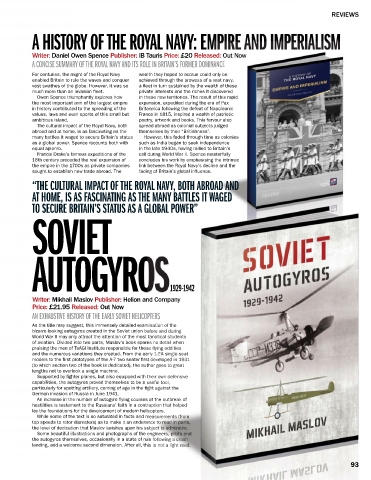
            SOVIET


            AUTOGYR


            Writer: Mikhail Maslov Publisher: Helion an      1929-1942
            Price: £21.95 Released: Out Now
            ANEXHAUSTIVEHISTORYOFTHEEARLYSOVIETHELICO

            As the title may suggest, this immensely detailed exam
            bizarre-looking autogyros created in the Soviet union b
            World War II may only attract the attention of the most
            of aviation. Divided into two parts, Maslov’s book spare
            praising the men of TsAGI Institute responsible for the
            and the numerous variations they created. From the ea
            models to the irst prototypes of the A-7 two seater irs
            (to which section two of the book is dedicated), the aut
            lengths not to overlook a single machine.
              Supported by ighter planes, but also equipped with
            capabilities, the autogyros proved themselves to be a
            particularly for spotting artillery, coming of age in the i
            German invasion of Russia in June 1941.
              An increase in the number of autogyro lying courses
            hostilities is testament to the Russians’ faith in a cont
            lay the foundations for the development of modern hel
              While some of the text is so saturated in facts and m
            top speeds to rotor diameters) as to make it an endura
            the level of dedication that Maslov lavishes upon his su
              Some beautiful illustrations and photographs of the
            the autogyros themselves, occasionally in a state of ru
            landing, add a welcome second dimension. After all, th


                                                                                                                            93

