


Page 88 - History of War - Issue 25-16
P. 88
OPERATOR’S HANDBOOK


          DESIGN                                                                                          developed by Rolls-
                                                                                                            Afterburning jets
          Each nation had a pressing need to replace old                                                Royce gave supersonic
          airframes, but all had diverse requirements, so the                                                 performance
          decision was taken to jointly develop a multi-role
          aircraft capable of being adapted for use across
          several capabilities ranging from low-level ground
          attack to high-altitude precision bombing, and also as
          an interceptor/ighter. Canada withdrew for political
          reasons, as it was felt that the aircraft manufacturing
          would all be undertaken in Europe, while Belgium
          chose the French Mirage 5.
           In 1968, the project was given the name MRCA
          (Multi Role Combat Aircraft), and the following year
          aerospace companies from Britain, Germany, Italy and
          the Netherlands formed a joint company called Panavia
          to develop and manufacture the new jet.
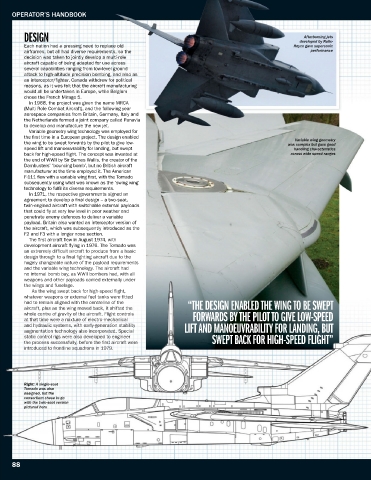
           Variable geometry wing technology was employed for
          the irst time in a European project. The design enabled
                                                                                                         Variable wing geometry
          the wing to be swept forwards by the pilot to give low-
                                                                                                      was complex but gave good
          speed lift and manoeuvrability for landing, but swept                                         handling characteristics
          back for high-speed light. The concept was invented at                                       across wide speed ranges
          the end of WWII by Sir Barnes Wallis, the creator of the
          Dambusters’ ‘bouncing bomb’, but no British aircraft
          manufacturer at the time employed it. The American
          F-111 lew with a variable wing irst, with the Tornado
          subsequently using what was known as the ‘swing wing’
          technology to fulil its diverse requirements.
           In 1971, the respective governments signed an
          agreement to develop a inal design – a two-seat,
          twin-engined aircraft with switchable external payloads
          that could ly at very low level in poor weather and
          penetrate enemy defences to deliver a variable
          payload. Britain also wanted an interceptor version of
          the aircraft, which was subsequently introduced as the
          F2 and F3 with a longer nose section.
           The irst aircraft lew in August 1974, with
          development aircraft lying in 1976. The Tornado was


          Right: A single-seat
          Tornado was also
          designed, but the
          consortium chose to go
          with the twin-seat version
          pictured here


     88

