


Page 89 - History of War - Issue 25-16
P. 89
PANAVIA TORNADO


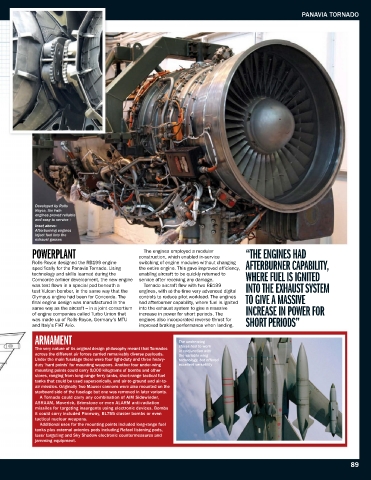
             Developed by Rolls
             Royce, the twin
             engines proved reliable
             and easy to service
             Inset above:
             Afterburning engines
             inject fuel into the
             exhaust gasses
            POWERPLANT                            construction, which enabled in-service  “THE ENGINES HAD
                                                    The engines employed a modular
            Rolls-Royce designed the RB199 engine  the entire engine. This gave improved eficiency, AFTERBURNER CAPABILITY,
                                                  switching of engine modules without changing
            speciically for the Panavia Tornado. Using
            technology and skills learned during the  enabling aircraft to be quickly returned to  WHERE FUEL IS IGNITED
            Corncorde airliner development, the new engine  service after receiving any damage.
                                                    Tornado aircraft lew with two RB199
            was test lown in a special pod beneath a  engines, with at-the-time very advanced digital INTO THE EXHAUST SYSTEM
            test Vulcan bomber, in the same way that the
            Olympus engine had been for Concorde. The  had afterburner capability, where fuel is ignited TO GIVE A MASSIVE
                                                  controls to reduce pilot workload. The engines
            inal engine design was manufactured in the
            same way as the aircraft – in a joint consortium  into the exhaust system to give a massive  INCREASE IN POWER FOR
            of engine companies called Turbo Union that  increase in power for short periods. The
                                                  engines also incorporated reverse thrust for
            was made up of Rolls-Royce, Germany’s MTU  improved braking performance when landing. SHORT PERIODS”
            and Italy’s FIAT Avio.
             ARMAMENT                                           The under-wing

                                                                stores had to work
             The very nature of its original design philosophy meant that Tornados  in conjunction with
             across the different air forces carried remarkably diverse payloads.  the variable wing
             Under the main fuselage there were four light-duty and three heavy-  technology, but offered
             duty ‘hard points’ for mounting weapons. Another four under-wing  excellent versatility
             mounting points could carry 9,000 kilograms of bombs and other
             stores, ranging from long-range ferry tanks, short-range tactical fuel
             tanks that could be used supersonically, and air-to-ground and air-to-
             air missiles. Originally Two Mauser cannons were also mounted on the
             starboard side of the fuselage but one was removed in later variants.
               A Tornado could carry any combination of AIM Sidewinder,
             ASRAAM, Maverick, Brimstone or even ALARM anti-radiation
             missiles for targeting insurgents using electronic devices. Bombs
             it could carry included Paveway, BL755 cluster bombs or even
             tactical nuclear weapons.
               Additional uses for the mounting points included long-range fuel
             tanks plus external avionics pods including Rafael listening pods,
             laser targeting and Sky Shadow electronic countermeasures and
             jamming equipment.


                                                                                                                            89

