


Page 67 - BBC Wildlife Volume 36 #12
P. 67
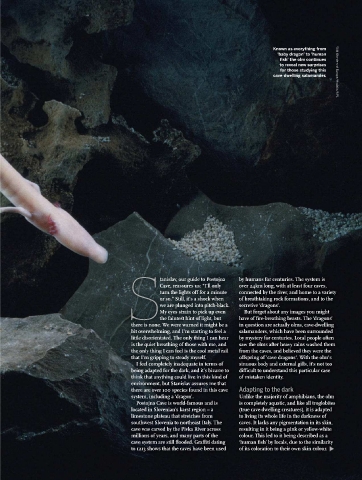
Known as everything from
                                                                                                                                 'baby dragon' to 'human
                                                                                                                                  fish' the olm continues
                                                                                                                                  to reveal new surprises
                                                                                                                                  for those studying this   Wild Wonders of Europe/Hodalic/NPL
                                                                                                                               cave-dwelling salamander.


                                                                           tanislav, our guide to Postojna     by humans for centuries. The system is
                                                                           Cave, reassures us: “I'll only      over 24km long, with at least four caves,
                                                                           turn the lights off for a minute    connected by the river, and home to a variety
                                                                           or so.” Still, it’s a shock when    of breathtaking rock formations, and to the
                                                                           we are plunged into pitch-black.    secretive ‘dragons’.
                                                                           My eyes strain to pick up even         But forget about any images you might
                                                             Sthe faintest hint of light, but                  have of fire-breathing beasts. The ‘dragons’
                                                              there is none. We were warned it might be a      in question are actually olms, cave-dwelling
                                                              bit overwhelming, and I’m starting to feel a     salamanders, which have been surrounded
                                                              little disorientated. The only thing I can hear   by mystery for centuries. Local people often
                                                              is the quiet breathing of those with me, and     saw the olms after heavy rains washed them
                                                              the only thing I can feel is the cool metal rail   from the caves, and believed they were the
                                                              that I’m gripping to steady myself.              offspring of 'cave dragons'. With the olm's
                                                                I feel completely inadequate in terms of       sinuous body and external gills, it’s not too
                                                              being adapted for the dark, and it’s bizarre to   difficult to understand this particular case
                                                              think that anything could live in this kind of   of mistaken identity.
                                                              environment, but Stanislav assures me that
                                                              there are over 100 species found in this cave    Adapting to the dark
                                                              system, including a ‘dragon’.                    Unlike the majority of amphibians, the olm
                                                                Postojna Cave is world-famous and is           is completely aquatic, and like all troglobites
                                                              located in Slovenian’s karst region – a          (true cave-dwelling creatures), it is adapted
                                                              limestone plateau that stretches from            to living its whole life in the darkness of
                                                              southwest Slovenia to northeast Italy. The       caves. It lacks any pigmentation in its skin,
                                                              cave was carved by the Pivka River across        resulting in it being a pink or yellow-white
                                                              millions of years, and many parts of the         colour. This led to it being described as a
                                                              cave system are still flooded. Graffiti dating     ‘human fish’ by locals, due to the similarity
                                                              to 1213 shows that the caves have been used      of its coloration to their own skin colour.

