


Page 68 - BBC Wildlife Volume 36 #12
P. 68
OLMS


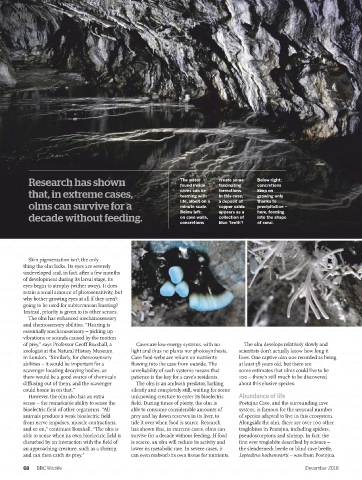
              Research has shown                                                    The water         create some       Below right:
                                                                                    found inside
                                                                                                                        concretions
                                                                                                      fascinating
              that, in extreme cases,                                               caves can be      formations.       keep on
                                                                                    teaming with
                                                                                                      In this case,
                                                                                                                        growing only
                                                                                    life, albeit on a  a deposit of     thanks to
              olms can survive for a                                                minute scale.     copper oxide      precipitation –
                                                                                    Below left:       appears as a      here, forming
              decade without feeding.                                               on cave walls,    collection of     into the shape
                                                                                    concretions       blue 'teeth'!     of coral.


              Skin pigmentation isn’t the only
            thing the olm lacks. Its eyes are severely
            undeveloped and, in fact, after a few months
            of development during its larval stage, its
            eyes begin to atrophy (wither away). It does
            retain a small amount of photosensitivity, but
            why bother growing eyes at all if they aren’t
            going to be used for subterranean hunting?
            Instead, priority is given to its other senses.
              The olm has enhanced mechanosensory
            and chemosensory abilities. “Hearing is
            essentially mechanosensory – picking up
            vibrations or sounds caused by the motion
            of prey,” says Professor Geoff Boxshall, a          Caves are low-energy systems, with no             The olm develops relatively slowly and
            zoologist at the Natural History Museum           light and thus no plants nor photosynthesis.     scientists don’t actually know how long it
            in London. “Similarly, for chemosensory           Cave food-webs are reliant on nutrients          lives. One captive olm was recorded as being
            abilities – it would be important for a           flowing into the cave from outside. The           at least 58 years old, but there are
            scavenger locating decaying bodies, as            unreliability of such systems means that         some estimates that olms could live to be
            there would be a good source of chemicals         patience is the key for a cave’s residents.      100 – there's still much to be discovered
            diffusing out of them, and the scavenger            The olm is an ambush predator, lurking         about this elusive species.
            could home in on that.”                           silently and completely still, waiting for some
              However, the olm also has an extra              unknowing creature to enter its bioelectric      Abundance of life
            sense – the remarkable ability to sense the       field. During times of plenty, the olm is         Postojna Cave, and the surrounding cave
            bioelectric field of other organisms. “All         able to consume considerable amounts of          system, is famous for the unusual number
            animals produce a weak bioelectric field           prey and lay down reserves in its liver, to      of species adapted to live in this ecosystem.
            from nerve impulses, muscle contractions,         tide it over when food is scarce. Research       Alongside the olm, there are over 100 other
            and so on,” continues Boxshall. “The olm is       has shown that, in extreme cases, olms can       troglobites in Postojna, including spiders,
            able to sense when its own bioelectric field is    survive for a decade without feeding. If food    pseudoscorpions and shrimp. In fact, the
            disturbed by an interaction with the field of      is scarce, an olm will reduce its activity and   first ever troglobite described by science –
            an approaching creature, such as a shrimp,        lower its metabolic rate. In severe cases, it    the slenderneck beetle or blind cave beetle,
            and can then catch its prey.”                     can even reabsorb its own tissue for nutrients.   Leptodirus hochenwartii – was from Postojna.


            68    BBC Wildlife                                                                                                                December 2018

