


Page 69 - BBC Wildlife Volume 36 #12
P. 69
First discovered by cave lamplighter Luka
            ˇ
               ˇ
            Cec, the beetle was passed on to Count Franz
            Josef von Hochenwart – who was creating a
            guidebook to the caves – who passed it on
            to beetle expert Ferdinand Schmidt.
              “It did not take long for Schmidt to
            realise this was a true troglobite,” explains
            Katja Dolenc Batagelj from Postojna Cave
            management. “The scientific circles were
            thrilled by the discovery and, because of
            the beetle and further discoveries, Postojna
            Cave became known as the cradle of a
            new science – speleobiology, the study of
            subterranean animals.”
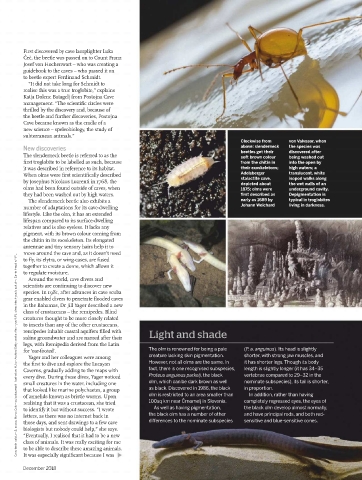
                                                                                                                Clockwise from        von Valvasor, when
            New discoveries                                                                                     above: slenderneck    the species was
                                                                                                                beetles get their     discovered after
            The slenderneck beetle is referred to as the                                                        soft brown colour     being washed out
            first troglobite to be labelled as such, because                                                     from the chitin in    into the open by
            it was described in reference to its habitat.                                                       their exoskeletons;   high waters; a
            When olms were first scientifically described                                                         Adelsberger           translucent, white
                                                                                                                stalactite cave,      isopod walks along
            by Josephus Nicolaus Luarenti in 1768, the
                                                                                                                depicted about        the wet walls of an
            olms had been found outside of caves, when                                                          1875; olms were       underground cavity.
            they had been washed out by high waters.                                                            first described as     Depigmentation is
              The slenderneck beetle also exhibits a                                                            early as 1689 by      typical in troglobites
                                                                                                                Johann Weichard       living in darkness.
            number of adaptations for its cave-dwelling
            lifestyle. Like the olm, it has an extended
            lifespan compared to its surface-dwelling
            relatives and is also eyeless. It lacks any
            pigment, with its brown colour coming from
            the chitin in its exoskeleton. Its elongated
            antennae and tiny sensory hairs help it to
            move around the cave and, as it doesn’t need
         Cave, teeth, calcium & isopod; Marco Colombo/calosoma.it; illustration: Hulton Archive/Getty beetle: Alex Hyde/NPL; olms: Alex Hyde; black olm; Daniel Heuclin/NPL
            to fly, its elytra, or wing-cases, are fused
            together to create a dome, which allows it
            to regulate moisture.
              Around the world, cave divers and
            scientists are continuing to discover new
            species. In 1981, after advances in cave scuba
            gear enabled divers to penetrate flooded caves
            in the Bahamas, Dr Jill Yager described a new
            class of crustaceans – the remipedes. Blind
            creatures thought to be more closely related
            to insects than any of the other crustaceans,
            remipedes inhabit coastal aquifers filled with
            saline groundwater and are named after their              Light and shade
            legs, with Remipedia derived from the Latin
            for ‘oar-footed’.                                         The olm is renowned for being a pale        (P. a. anguinus). Its head is slightly
              Yager and her colleagues were among                     creature lacking skin pigmentation.         shorter, with strong jaw muscles, and
            the first to dive and explore the Lucayan                  However, not all olms are the same. In      it has shorter legs. Though its body
            Caverns, gradually adding to the maps with                fact, there is one recognised subspecies,   length is slightly longer (it has 34–35
            every dive. During these dives, Yager noticed             Proteus anguinus parkelj, the black         vertebrae compared to 29–32 in the
            small creatures in the water, including one               olm, which can be dark brown as well        nominate subspecies), its tail is shorter,
            that looked like marine polychaetes, a group              as black. Discovered in 1986, the black     in proportion.
            of annelids known as bristle worms. Upon                  olm is restricted to an area smaller than     In addition, rather than having
                                                                                     ˇ
            realising that it was a crustacean, she tried             100sq km near Crnomelj in Slovenia.         completely regressed eyes, the eyes of
            to identify it but without success. “I wrote                As well as having pigmentation,           the black olm develop almost normally,
            letters, as there was no internet back in                 the black olm has a number of other         and have principal rods, and both red-
            those days, and sent drawings to a few cave               diferences to the nominate subspecies       sensitive and blue-sensitive cones.
            biologists but nobody could help,” she says.
            “Eventually, I realised that it had to be a new
            class of animals. It was really exciting for me
            to be able to describe these amazing animals.
            It was especially significant because I was


            December 2018

