


Page 70 - BBC Wildlife Volume 36 #12
P. 70
OLMS


                                                                                                                 Brought to life


                                                                                                                 In2016,fortheirsttimeinPostojna’shistory,
                                                                                                                 scientistsandthepublicwitnessedafemale
                                                                                                                 olm laying her eggs in an aquarium.


                                                                                                                 IN ISOLATION
                                                                                                                 The mother
                                                                                                                 fiercely protected
                                                                                                                 her first egg
                                                                                                                 from the other
                                                                                                                 olms in the tank,
                                                                                                                 prompting the
                                                                                                                 scientists to
                                                                                                                 relocate them to a separate tank – easier to
                                                                                                                 relocate them than the anxious female.
                                                                                                                 Infrared cameras were installed in the tank.


                                                                                                                 ON THE
                                                                                                                 ROCKS
                                                                                                                 For two months,
                                                                                                                 the female laid a
                                                                                                                 total of 64 eggs
                                                                                                                 – the majority on
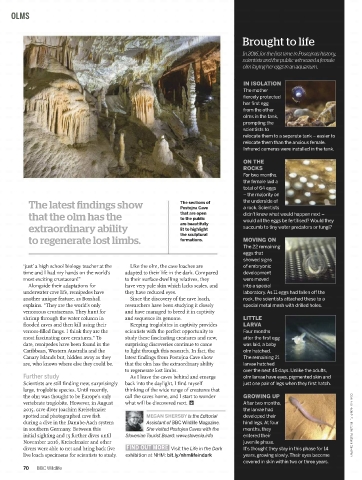
              The latest indings show                                               The sections of              the underside of
                                                                                                                 a rock. Scientists
                                                                                    Postojna Cave
              that the olm has the                                                  that are open                didn’t know what would happen next –
                                                                                    to the public
                                                                                    are beautifully              would all the eggs be fertilised? Would they
              extraordinary ability                                                 lit to highlight             succumb to tiny water predators or fungi?
                                                                                    the sculptural
              to regenerate lost limbs.                                             formations.                  MOVING ON
                                                                                                                 The 22 remaining
                                                                                                                 eggs that
                                                                                                                 showed signs
            ‘just’ a high school biology teacher at the      Like the olm, the cave loaches are                  of embryonic
            time and I had my hands on the world’s         adapted to their life in the dark. Compared           development
            most exciting crustacean!”                     to their surface-dwelling relatives, they             were moved
              Alongside their adaptations for              have very pale skin which lacks scales, and           into a special
            underwater cave life, remipedes have           they have reduced eyes.                               laboratory.As 11 eggs had fallen of the
            another unique feature, as Boxshall              Since the discovery of the cave loach,              rock, the scientists attached these to a
            explains. “They are the world’s only           researchers have been studying it closely             special metal mesh with drilled holes.
            venomous crustaceans. They hunt for            and have managed to breed it in captivity
            shrimp through the water column in             and sequence its genome.                              LITTLE
            flooded caves and then kill using their           Keeping troglobites in captivity provides           LARVA
            venom-filled fangs. I think they are the        scientists with the perfect opportunity to            Four months
            most fascinating cave creatures.” To           study these fascinating creatures and new,            after the first egg
            date, remipedes have been found in the         surprising discoveries continue to come               was laid, a baby
            Caribbean, Western Australia and the           to light through this research. In fact, the          olm hatched.
            Canary Islands but, hidden away as they        latest findings from Postojna Cave show                The remaining 21
            are, who knows where else they could be.       that the olm has the extraordinary ability            larvae hatched
                                                           to regenerate lost limbs.                             over the next 45 days. Unlike the adults,
            Further study                                    As I leave the caves behind and emerge              olm larvae have eyes, pigmented skin and
            Scientists are still finding new, surprisingly  back into the daylight, I find myself                  just one pair of legs when they first hatch.
            large, troglobite species. Until recently,     thinking of the wide range of creatures that
            the olm was thought to be Europe’s only        call the caves home, and I start to wonder            GROWING UP
            vertebrate troglobite. However, in August      what will be discovered next.                         After two months,
            2015, cave diver Joachim Kreiselmaier                                                                the larvae had
            spotted and photographed cave fish                        MEGAN SHERSBY is the Editorial              developed their
            during a dive in the Danube-Aach system                  Assistant of BBC Wildlife Magazine.         hind legs.At four                                 Cave: Alex Hyde/NPL; life cycle:  Postojna Cave Park
            in southern Germany. Between this                        She visited Postojna Caves with the         months, they
            initial sighting and 15 further dives until    Slovenian Tourist Board: www.slovenia.info            entered their
            November 2016, Kreiselmaier and other                                                                juvenile phase.
            divers were able to net and bring back five     FIND OUT MORE Visit the Life in the Dark              It's thought they stay in this phase for 14
            live loach specimens for scientists to study.   exhibition at NHM: bit.ly/nhmlifeindark              years, growing slowly.Their eyes become
                                                                                                                 covered in skin within two or three years.
            70    BBC Wildlife

