


Page 77 - History of War - Issue 05-14
P. 77
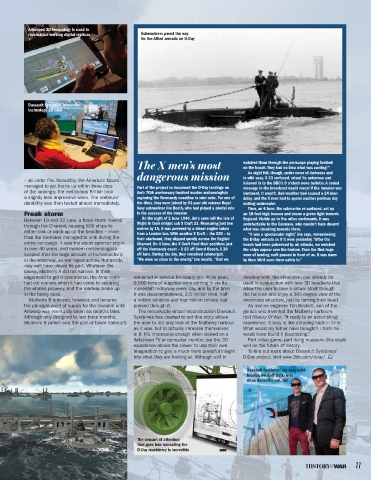
Advanced 3D technology is used to
               reconstruct working digital replicas    Submariners paved the way
                                                       for the Allied armada on D-Day


               Dassault Systèmes’ immersive-
               technology 3D cave


                                                     The X men’s most                      watched them through the periscope playing football
                                                                                           on the beach. They had no idea what was coming!”
                                                     dangerous mission                       As night fell, though, under cover of darkness and
              – all under fire. Incredibly, the American forces                             in wild seas, X 23 surfaced, raised its antennae and
                                                                                           listened in to the BBC’s 9 o’clock news bulletin. A coded
              managed to get theirs up within three days    Part of the project to document the D-Day landings on   message in the broadcast would reveal if the invasion was
              of the landings; the meticulous British took    their 70th anniversary involved marine archaeologists   imminent. It wasn’t. Bad weather had caused a 24-hour
              a slightly less impressive week. The harbours’   exploring the Normandy coastline in mini-subs. For one of   delay, and the X men had to spend another perilous day
              durability was then tested almost immediately.   the dives, they were joined by 93-year-old veteran Royal   waiting underwater.
                                                     Navy submariner Jim Booth, who had played a pivotal role   Then, on 6 June, the submarine re-surfaced, set up
              Freak storm                            in the success of the invasion.       an 18-foot-high beacon and shone a green light towards
                                                       On the night of 2 June 1944, Jim’s crew left the Isle of
              Between 19 and 22 June, a freak storm howled   Wight in their midget sub X Craft 23. Measuring just two   England. Visible up to five miles northwards, it was
              through the Channel, causing 800 ships to    metres by 15, it was powered by a diesel engine taken    undetectable to the Germans, who couldn’t have dreamt
              either sink or wash up on the beaches – more   from a London bus. With another X Craft – the X20 – to   what was steaming towards them.
                                                                                             “It was a spectacular sight,” Jim says, remembering
              than the Germans managed to sink during the   their starboard, they slipped quietly across the English   the D-Day armada as if it were yesterday. “After the
              entire campaign. It was the worst summer storm   Channel. On 4 June, the X Craft fixed their positions just   beach had been pulverised by air attacks, we watched
              in over 40 years, and modern meteorologists   off the Normandy coast – X 23 off Sword Beach, X 20    the ships appear over the horizon. Then the first huge
              suspect that the huge amount of human activity   off Juno. During the day, they remained submerged.    wave of landing craft passed in front of us. It was dawn
              in the waterway, as war raged across Normandy,   “We were so close to the enemy,” Jim recalls, “that we   by then. We’d seen them safely in.”
              may well have played its part. Whatever the
              cause, Mulberry A did not survive. In their
              eagerness to get it operational, the Americans   remained in service for nearly ten. At its peak,   development, the simulation can already be
              had cut corners when it had come to securing    9,000 tons of supplies were coming in via its   used in conjunction with new 3D headsets that
              the whales properly, and the roadway broke up    makeshift motorway every day, and by the time   allow the user to take a virtual stroll through
              in the heavy seas.                    it was decommissioned, 2.5 million men, half   the harbour and enjoy a 360-degree view of the
               Mulberry B survived, however, and became   a million vehicles and four million tonnes had   enormous structure, just by turning their head.
              the principle point of supply for the invasion until   passed through it.      As marine engineer Tim Beckett, son of the
              Antwerp was eventually taken six months later.   The remarkable virtual reconstruction Dassault   genius who invented the Mulberry harbours
              Although only designed to last three months,   Systèmes has created to tell this story allows    told History Of War, “It really is an astonishing
              Mulberry B (which was the size of Dover harbour!)   the user to not only look at the Mulberry harbour   experience. It truly is like stepping back in time.
                                                    as it was, but to actually immerse themselves   What would my father have thought? I think he
                                                    in it. It’s impressive enough when viewed on a   would have found it fascinating.”
                                                    flatscreen TV or computer monitor, but the 3D   Part video game, part living museum, this could
                                                    experience allows the viewer to use their own   well be the future of history.
                                                    imagination to give a much more powerful insight   To find out more about Dassault Systèmes’
                                                    into what they are looking at. Although still in   D-Day project, visit www.3ds.com/dday/. w

                                                                                            Dassault Systèmes’ lab specialist
                                                                                            Nicolas Serikoff (left) with
                                                                                            Allan Beckett’s son, Tim


                                                      The amount of attention
                                                      that goes into recreating the
                                                      D-Day machinery is incredible

                                                                                                                 HISTORY  WAR    77
                                                                                                                         of

